Learn, Improve, Connect: Your Modern Shuffleboard Hub
Learn, Improve, Connect: Your Modern Shuffleboard Hub
TERMS • DEFINITIONS • CONTEXT
Unabridged Shuffleboard Dictionary
Search and browse court-shuffleboard terminology, including playing terms, strategy language, equipment, court features, tournament terminology, organizations, and regional usage.
Terminology is not always universal
Some court-shuffleboard terms vary by organization, country, state, club, or historical source. Definitions preserve those distinctions where they are part of the source material. A Dictionary definition is not automatically a current governing rule.
Search or browse the Dictionary
Use the search box or alphabetical index below to find a term.
There are currently 82 defined terms in this directory beginning with the letter S.
S
Sanchez
1, A shot that intentionally or unintentionally involves multiple struck live discs resulting in a hoped for or unexpected exceptional outcome for the shooter. || Named after Carl Sanchez, a player at the St. Petersburg Shuffleboard club in the 1960s and 1970s, who often chose the more complicated, fancier shot over the simpler higher-percentage shot. He was renowned for often succeeding at such shots, but overall was not a winning tournament player due to his preference for showmanship over best strategy. (Example: "His Sanchez gave him 25 points for the frame, to recover the lead.") 2. A shot that puts two of the opponent's discs in the kitchen as well as scoring one or more of the shooter's discs.
Sand
1. Fine clean sand that is sprinkled on a court to reduce the friction between the bottom of the discs and the court surface, now rarely used and not recommended for modern courts. 2. BEADS.
Score
1. Make a shot such that one or more discs of one’s own color becomes a scoring disc. 2. The current total points of each of the competing players or player teams in the game being played. 3. SCORING DISC.
Score One's Hammer
1. Score at least 7 more points than one's opponent for an end where one had the hammer shot. 2. Shoot the hammer disc such that it adds at least one scoring disc to one's total for the end.
Scoreboard
The display board at the head of a court used to record and accumulate player or partner-team scores at the completion of each frame of a game.
Scorecard
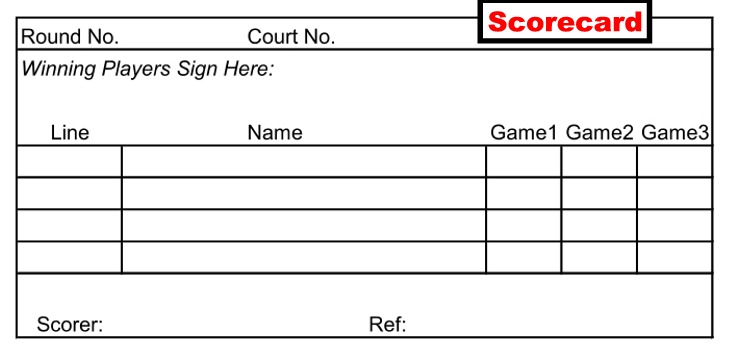
At tournaments, a printed card on which the scorekeeper or the players record their match results, to be turned in to the Tournament Director after completion of a match.
Scorekeeper
The person who tallies and records on the scoreboard of a court the scores of players or teams at the completion of each end of play. Syn: SCORER.
Scorekeeper, Head
The tournament official that assigns and oversees all scorekeepers.
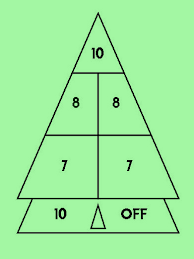
Each of the areas within the scoring diagram where a live disc is a scoring disc, including the 7s, 8s, 10 and 10-Off.
Scoring Diagram
The set of painted lines at each end of the court, mostly triangular in overall shape, that define the areas where stopped live discs score points. Sometimes the term excludes the area forming the 10-Off. Syn: BOARD, HOUSE, SCORING TRIANGLE, SHUFFLEGRAM, TRIANGLE.
Scoring Disc
A live disc that has stopped inside the scoring diagram not touching any lines with the exception of the lines of the separation triangle in the 10-Off. Syn: COUNTER, NUMBER, SCORE.
Shaping a newly manufactured disc. New discs often have a somewhat concave or convex bottom surface, and often lack a beveled edge. The discs must be put through the shaping process to give them good performance characteristics.
See
Discern a portion of a hidden disc that is sufficiently exposed to be targeted by a direct shot of the cue disc.
Separation Triangle
The painted triangle in the center of the starting area that separates the starting area into two equal halves, one for each of the two colors of discs. Often it is painted as just two angled lines that outline a triangular shape. Syn: CARET, DIVIDER, DIVIDING TRIANGLE.
Setup
Placement by a player at the receiving end, in a set or requested pattern or location on the board, of one or more target discs or of an end of a cue for targeting by the shooter of practice shots before the start of a game. Placement of opponent’s discs as target discs for setup is not allowed in some locales.
Altering the shape of a disc by sanding to achieve smooth movement and speed. The goal of shaping is a flat and smooth bottom surface, often with a beveled bottom edge.
The end where cue discs are shot from for a frame.
Shooting, Path
A technique of shooting wherein the player determines the path forward that the cue disc must follow from the start of the push forward until the disc leaves contact with the cue head, for correct aim of the disc. The player focuses their gaze on the cue head throughout most or all of the shot to ensure that the cue disc follows the correct path.
Shooting, Sight
A technique of shooting wherein the player sights the aiming spot at the opposite end of the court and focuses their gaze on this spot through most or all of the shot for correct aim of the disc.
Shooting, Spot
A technique of shooting wherein the player determines a spot on the nearest scoring diagram that the cue disc must cross over for correct aim of the disc. The player focuses their gaze on the spot throughout most or all of the shot to ensure that the cue disc passes over this spot.
A 75-point game format wherein both players or partner teams starts with a score of 43 or 45. Used mainly in friendly games to practice proper end-game strategy for tournaments.
Shot
The technique and motions of propelling a cue disc with a cue towards the opposite end of the court by a player. The components of a shot are Grip, Stance, Aim, Steps, Swing and Follow-Through.
Shots, Practice
A set of shots by each player on the court taken before the start of a game to learn about the characteristics of the court and the discs, and to practice shooting before game play. Before the first two games of a match in Florida official tournaments, there are usually two speed shots by each player, followed by four setup shots for each player, and then four more setup shots for each player. Officially, the term Practice Shots refers to the setup shots only, exclusive of the speed shots, but sometimes the term is used to mean both the speed shots and practice shots together (as does the term Practice Round). In some other states, there are for each player just four practice shots that are not setup shots.
Shots, Setup
Practice shots taken before game play exclusive of any speed shots, with setups allowed.
Shots, Speed
Shots before the start of a game to learn about the speed of the court and discs. There are usually two speed shots for each player prior to the practice shots before a game begins. Players are not allowed to use setups for speed shots.
The left or right half of the court identified by the color played from the starting area on that half. A court has two sides, yellow and black. Viewed from the head of the court, yellow is on the right side and black on the left side.
Sidelines
1. The diagonal lines of the scoring diagram that define the sides of the 7 and 8 scoring areas. Syn: ANGLE LINES, OUTSIDE LINES. 2. The diagonal lines along the sides of the 10-Off.
Silent Captain
The scoreboard as a guidepost to decide during a game one's best choice of shot or game strategy going forward, taking into account the current recorded scores on the scoreboard, the number of points or frames remaining in the game, which color has the current hammer, the color that has the next hammer(s), and other strategic factors.
Singles
1. A game wherein one player competes against one other player. 2. A tournament format wherein players enter the tournament individually rather than as partner teams and each match is played as one player competing against one other player. Syn: SGLS.
Singles Mingle
1. A tournament format wherein players start out playing a series of singles games (hence "Singles") in a mingle singles format, with two separate divisions - one for men and one for women. When this portion of the tournament is complete, the top eight players from each division are combined for a draw doubles bracket competition, partnered by random draw in mixed partner teams of one man and one woman (hence "Mingle"), to play for the final four winning places. 2. A misnomer for "Mingle Singles".
Sit On It
1. When clearing a scoring disc, intentionally cause the cue disc to stick as a scoring disc in a high position such that it is difficult for the opponent to score when clearing it. 2. SNUGGLE.
1. (of a court) Requires more propelling force than usual to slide discs from one end to the other due to the condition of the court. 2. (of a disc) takes more force than usual to be propelled down the court due to the condition of the disc.
Slow Play
Take excessive time to make shots. Repeated slow play in tournament may be subject to penalty, in some locales defined as more than 45 seconds to make a shot.
Sneak
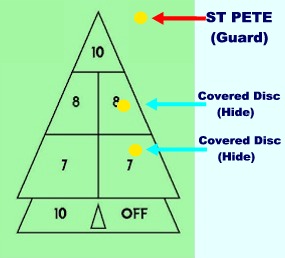
1. A shot to directly place the cue disk in a scoring position that is protected by an existing guard when shot between two guards or behind a guard that is in a position that usually acts as a guard for the opponent. 2. Shoot such a shot. 3. HIDE (def. 2).
SNGLS
SINGLES (def. 2). An abbreviation used on tournament schedules.
Snuggle
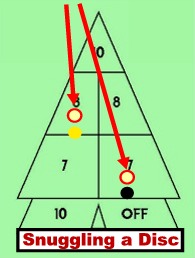
Place a disc, usually as a scoring disc, close to or touching, and in front of, a live disc. Syn: CUDDLE, JOIN, NESTLE, SIT ON IT.
Soft
(of a shot) Relatively slow.
Soup
10-OFF || Derived from the circular motion given as a hand signal when a disc lands in the 10-Off, representing the circle placed around a negative score on the scoreboard. This motion is visually equivalent to the stirring of a pot of soup, which is also tied to the literal sense of the term "kitchen", also used for the 10-Off.
A competition between a number of players, each shooting on a separate court, wherein all players shoot single discs synchronously on command of a referee until a complete set of discs are shot for the frame, each trying to accumulate the most points for the frame. Usually, a disc in the kitchen scores plus ten points instead of minus ten, and usually the number of frames played is equal to the number of players competing, often with players rotating to a different court for each frame. This format is primarily used to break ties between players at the end of a round in a round-robin competition.
Spinner
An electro-mechanical machine that spins discs to facilitate cleaning and waxing of the bottoms. Usually a wooden box enclosing one or two electric spin motors, often repurposed from a floor waxing machine, with attached spinning platforms on which discs are laid bottom up. To apply a coat of wax, with the motor spinning the disc a solid wax stick is drawn across the bottom, or a paste wax is spread on it with a soft cloth.
Split
A setup for a practice shot where the target disc is placed straddling the centerline between the 8s at the receiving end, to allow the shooter to attempt to double the target disc.
A guard that is about halfway between the apex of the scoring diagram and an edge of the court. A St. Pete is usually an effective guard for a player when positioned on the same side of the court as the player's opponent. Syn: CROSS GUARD, CROSS PILOT.
The position of a player's body in preparation to make a shot.
Stance: Stand with your feet a comfortable distance apart, feet evenly square to your shoulders, weight distributed evenly between your feet. Set the head of your cue against the disc, then move your body to place your arm hanging loosely by your side, and your hand next to your hip.
Standing Area
The area of the court between the rear edge and the baseline, where players stand and step when shooting discs. Syn: APPROACH, APRON, SHOOTING AREA.
Starting Area
The 10-Off section of the scoring diagram at the end from which the players are shooting. Before the start of an end, all the discs are placed within the starting area before any disc is shot. In game formats wherein competing players shoot from the same end, one disc color assigned to each, the separation triangle separates the two colors of discs, yellow placed on the right and black on the left when shooting from the head of the court, or yellow on the left and black on the right when shooting from the foot. Syn: LAUNCHING AREA, STAGING AREA, SHOOTING AREA, STARTING PANEL. || This term, and its synonyms, may be used in either the singular or plural: Starting Area referring to both halves as one; or Starting Area referring to just one half side (e.g., "The yellow starting area.").
Starting Line
The 7/10-Off line at the shooting end. Once a cue disc is fully across this line, it is in play.
One of the four lateral positions of a disc within the starting area before being shot. The positions are named one through four on each side of the starting area, beginning with the position closest to the center, each position accommodating one disc. (Example: "He prefers to shoot most of the time from the one, and almost never from the two-and-a-half. But his opponent on black shoots most of the time from the two.")
State Amateur
(in Florida) A player advances their player status from District Amateur to State Amateur (effective the following October 1st) after accumulating a sufficient number of Move-Up Points (5 points within a three-season period) by placing in several FSA tournaments that award such points to Amateur players. Once a State Amateur, the player must accumulate additional Move-Up Points (5 points within a new three-season period) to advance their player status to Pro (effective the following October 1st).
State Points
(in Illinois) MASTERS POINTS.
State Sponsored Tournament
(in Florida) Any of the six tournaments conducted annually by the FSA: Singles Championship; Doubles Championship; Amateur Singles Championship; Amateur Doubles Championship; Masters; and Tournament of Champions. The tournaments are rotated annually between the FSA Districts, on a published rotation schedule, each one hosted by one of the member clubs in the assigned District.
Statewide Tournament
(in Florida) A tournament that is open to all players that have a membership to any member club of the FSA. Statewide tournaments are hosted by member clubs, as approved by the club's District and the FSA, and published on the FSA Open Tournament Schedule or the FSA Amateur Tournament Schedule, as well as on the District's schedule.
Steal the Hammer
1. Prevent your opponent from scoring their hammer (see SCORE ONE'S HAMMER def. 2). Syn: STOP THE HAMMER. 2. Score the same or more points than one's opponent for an end where the opponent had the hammer shot.
Steam
A humorous descriptive to point out that a disc has landed in the kitchen. (Examples: "Your disc is steaming now!"; "The steam is rising on that one!") || A play on words of the colloquial term 'soup' for the 10-Off.
Steps
One or more steps forward taken by a player during a shot to impart motion to the cue disc.
Steps: Take a small step with the foot next to the cue. Don’t move the cue, hand, or stick while making the small step. Don’t let the cue head pull back from the disc. End the small step with your full weight on the forward foot, your hand now somewhat back of your hip. Next make a larger step with your other foot, ending with knee somewhat bent and full weight on that foot. (Alternatively, you can make just one large step with the foot opposite the cue but in that case, start with your hand somewhat back of your hip instead of next to it, elbow unbent.)
Stick
1. (of a disc) Stop on the board at or near the point of contact when clearing a target disc, usually unintentionally. 2. (of a disc) Stop somewhere exposed on the board. 3. CUE. 4. TANG (def. 1).
1. A too-narrow St. Pete or too-wide Tampa intentionally placed out of the correct position to tempt the opponent to use it as their own guard, luring the opponent into shooting a disc on the board where it might be kitchened rather than shooting a clearing shot, a guard or a dead disc. 2. Any disc placement that lures the opponent to attempt to hide a disc when their best current strategy includes staying off the board to avoid the possibility of being kitchened.
Suicide Alley
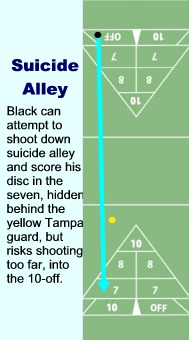
The path for shooting a disc that goes from the position in the starting area closest to the nearest edge of the court down to the other end on the same side, keeping towards that edge of the court. So named because the cue disc stops in the 10-Off instead of a scoring area when hiding behind a guard more often than on any other path down the court. Syn: ALLEY, PRIMROSE PATH.
Sweep a Court
Use a broom to sweep off all dressing from a court, as well as any dust, dirt and debris.
Swing
A continuous movement by a shooter of the hand and arm that moves the cue, to propel a cue disc forward for a shot. Syn: STROKE.
Swing: As your take the second larger step, or at the end of it, make a pendulum swing with the arm and hand holding the cue to push the disc. Keep your elbow unbent and push straight forward in the direction you have your body and cue aimed. Do not move your hand, wrist, arm, or stick to one side or the other to aim the disc – you have done all your aiming before the steps. The speed is not determined by the muscle strength you put into the shot, rather by the speed of the swing. For a faster shot, to send the disc faster or further, swing faster; for a slower shot, to send the disc slower or shorter, make a slower swing.
Swing, Pendulum
A swing that starts with the hand holding the cue extended back past the hip of the shooter and continues forward with an unbent arm out to the full extension forward, the arm and hand simulating the motion of a pendulum.
Source & scope
This online Dictionary is built from CourtShuffleboard.com’s prepared court-shuffleboard terminology dataset. It preserves source-specific and regional meanings where they matter and can be expanded carefully as additional terms are reviewed.
For current playing rules, use the governing rules for the organization, event, or location where you are playing.