Learn, Improve, Connect: Your Modern Shuffleboard Hub
Learn, Improve, Connect: Your Modern Shuffleboard Hub
TERMS • DEFINITIONS • CONTEXT
Unabridged Shuffleboard Dictionary
Search and browse court-shuffleboard terminology, including playing terms, strategy language, equipment, court features, tournament terminology, organizations, and regional usage.
Terminology is not always universal
Some court-shuffleboard terms vary by organization, country, state, club, or historical source. Definitions preserve those distinctions where they are part of the source material. A Dictionary definition is not automatically a current governing rule.
Search or browse the Dictionary
Use the search box or alphabetical index below to find a term.
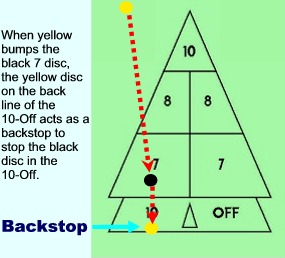
1. A disc on the scoring diagram that can be utilized as an aid to stop a moving disc at a position in front of it when struck by the moving disc. Often refers to a liner that, when struck head-on, will leave the moving disc stopped in a scoring position. 2. A low barrier at the front and rear edges of the court, in front of the player benches, that serves to stop or deflect any moving discs that reach the edge. Often composed of or reinforced with a shock-absorbent material, such as a sand-filled 2" pool drain hose, to prevent discs from rebounding to the board.
Bait
1. KITCHEN BAIT. 2. Tempt one's opponent by shooting a disc onto the board without a guard, to act as kitchen bait.
Ball's Law
"When you are ahead, everything goes right. When you are behind, nothing goes right." Originates from Mr. & Mrs. Richard Ball, the first to bring shuffleboard to land from cruise ships, in 1913.
Balpeen
A positive score of less than 7 on one’s hammer.
Bank
A fun game variation which requires discs to bounce off wooden bumpers placed along the alleys, from the 7/8 line at one end to 7/8 line at the other, for a scoring disc to count. Originally played on three of the terrazzo courts at St. Petersburg Shuffleboard Club in the 1960s.
Barricade
Stop one’s opponent from scoring the hammer by building a spread of three or more discs across the court above the scoring triangle, leaving little or no openings for a direct shot to score. Syn: BLOCK OUT, BUILD A WALL, CLUTTER THE TOP COURT.
Baseline
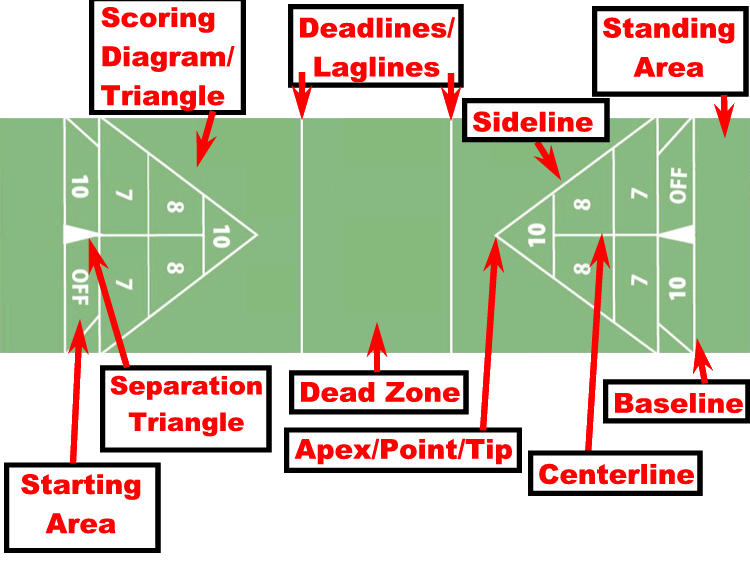
1. The horizontal line that separates the scoring diagram from the standing area. Syn: BACK LINE. 2. The imaginary horizontal line that includes the baseline (def. 1) and extends through the alleys on the two sides of the court. Syn: FOUL LINE.
Beader
A device for spreading beads on a court.
Beads
Fine glass or plastic globules that are sprinkled on the playing area of a court to reduce the friction between the bottoms of moving discs and the court surface. Syn: GLASS, SAND, WAX.
Beads, Dry
Beads that have not been treated to make them wind-resistant.
Beads, Glass
Beads made from glass.
Beads, Speed
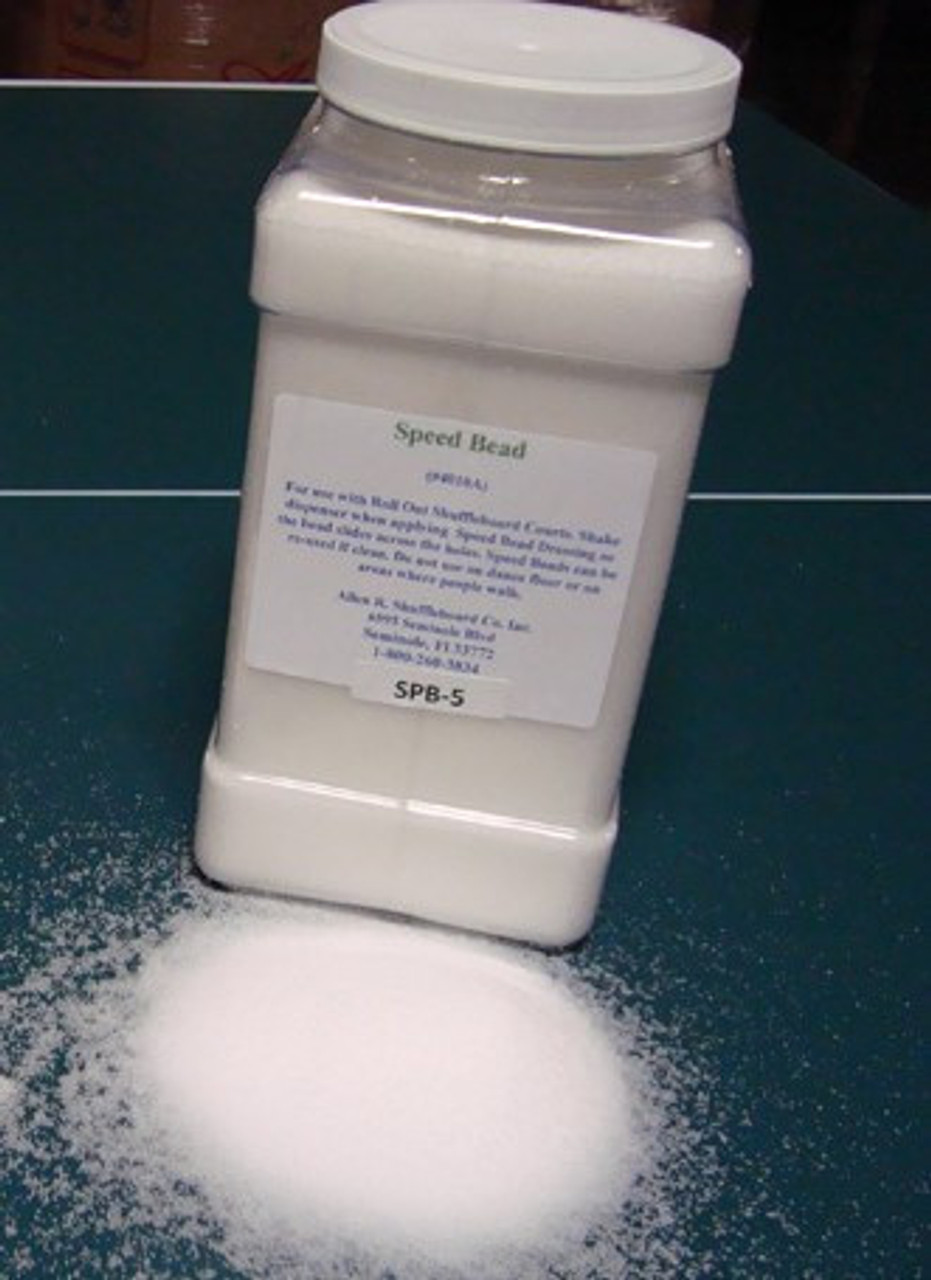
Beads made from plastic, for rollout courts.
Beads, Wet
Beads that have been treated to make them wind-resistant when spread on a court. Beads can be treated by coating with a small amount of silicone, glycerin, or glycerin-containing products (e.g., dish soap; Tire Shine). Syn: WIND-RESISTANT BEADS.
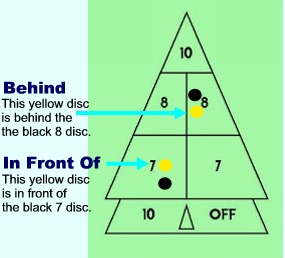
1. A position that is further away from the end of the shooters than a particular disc or location on the board. 2. Have a mathematical disadvantage in scores in the expectation to lose the game. The math takes into account current recorded scores on the scoreboard, any currently scoring discs, and the expectation that for the remainder of the game, every player scores their hammer shots but no additional discs.
1. The darker of the two colors of a set of discs. 2. The player who shoots this color discs. 3. The side of the court where this color discs are placed in the starting area.
Black Court
A court that favors the player or team shooting the black discs due to the drift of the court, aiding the black shooter to place a scoring disc hidden behind a Tampa or St Pete. Usually, a black court has more drift from the black side towards the yellow side (but if that drift is too strong, such a court might favor yellow instead).
Block
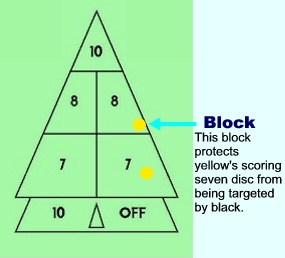
1. Make a shot that causes a disc to stop in a position obstructing one's opponent from targeting a particular live disc or section of the board. Syn: COVER, GUARD, HIDE. 2. A disc stopped in such a position. Syn: COVER, GUARD, HEAD BLOCK, HIDE, LID. 3. DISC.
Put up one or more blocks to limit the shots available to one's opponent for making a scoring disc.
Blocking Game
A game strategy that emphasizes the use of blocks to minimize the opponent's opportunities to make scoring discs, as contrasted with a clearing game or playing kitchen.
Board
1. All the playing surface of the court other than the standing areas, from the baseline at one end to the baseline at the other end. (Example: "The disc was removed from the board as it did not reach the deadline.") Also PLAYING AREA. 2. The portion of the court at the end opposite from the shooters that includes all areas where a stopped disc can be a live disc. (Example: "He cleared all the discs from the board.") 3. SCORING DIAGRAM. (Example: "Put up a guard before going on the board.")
Board Player
A player who favors shooting discs into the scoring areas rather than putting up guards or clearing the opponent's guards.
Bracket
1. Step ranges in game score, such as the "ten bracket" is a score from 10 to 19, the "twenty bracket" is a score from 20 to 29, etc. In the “Modular System” developed by the author Wilbur L. Estes, the scores -5, 11, 27, 43, and 59 are the lower limits of 16-point brackets, used in any 75-point doubles game for calculating which team is currently in the lead to determine the best strategy going forward (similarly, 8-point brackets are used instead for singles games). 2. In tournament play, the diagram for recording the match assignments, wins, losses, and advancements in ranking of the participating players or teams. A tournament may have more than one bracket, most commonly a Main Event Bracket that tracks the winners of the first match of the tournament and a Consolation Bracket that separately tracks the losers of the first match of the tournament, each bracket showing its own ranking of players or teams through the end of the tournament. 3. The pair of lines on a tournament chart that shows the two opposing players or teams for a round.
Buck Fever
The tendency to shoot the hammer short of its target due to the mental pressure of scoring one's hammer shot.
An automatic advancement of a player or team to the second round (def. 4) of a tournament without playing a match for the first round. A BYE occurs when there is no opponent player or team assigned to one of the two lines of a tournament bracket (def. 3), giving the player or team on the other line no opponent for that first round.
Source & scope
This online Dictionary is built from CourtShuffleboard.com’s prepared court-shuffleboard terminology dataset. It preserves source-specific and regional meanings where they matter and can be expanded carefully as additional terms are reviewed.
For current playing rules, use the governing rules for the organization, event, or location where you are playing.