Learn, Improve, Connect: Your Modern Shuffleboard Hub
Learn, Improve, Connect: Your Modern Shuffleboard Hub
TERMS • DEFINITIONS • CONTEXT
Unabridged Shuffleboard Dictionary
Search and browse court-shuffleboard terminology, including playing terms, strategy language, equipment, court features, tournament terminology, organizations, and regional usage.
Terminology is not always universal
Some court-shuffleboard terms vary by organization, country, state, club, or historical source. Definitions preserve those distinctions where they are part of the source material. A Dictionary definition is not automatically a current governing rule.
Search or browse the Dictionary
Use the search box or alphabetical index below to find a term.
A frame-game format wherein for the first round (in singles) or for the first two rounds (in doubles) only scoring discs in the 10 count, for the second round(s) only scoring discs in an 8 count, and for the third round(s) only scoring discs in a 7 count. This sequence either repeats or reverses for any subsequent rounds. Scoring discs in the 10-Off count either always as minus 10 points for the color (e.g., a yellow disc in the 10-Off counts as minus 10 for yellow), or always as plus 10 points for the opposite color (e.g., a yellow disc in the 10-Off counts as plus 10 for black).
The scoring area inside the lines of the scoring diagram located between the 7s and the standing area. Scoring discs wholly within the 10-Off, including touching or on the separation triangle, count as minus ten points or, in some game formats, as plus ten points. Syn: -10, KITCHEN, SOUP.
The horizontal line of the scoring diagram separating the 10 scoring area from the 8 scoring areas. Syn: 8/10 LINE.
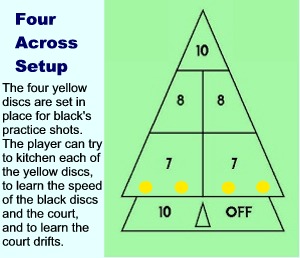
4-Across (Four-Across)
A setup for a set of four practice discs by placing four target discs, one each in or near each of the four corners of the deep sevens at the receiving end. A disc is placed by the outside deep corner of each seven and one by each deep corner formed by the centerline and the 7/10 line; or the four discs are placed in or near even spacing across the deep sevens. The player at the receiving end may use the end of their stick to represent the first target disc if there are no other discs yet at that end to use for the setup, and then follow by using the shot discs for the next three setup positions.
A game format wherein two competing players shoot from opposite ends, highest score at the end of any round in which one or both players have a score of 51 or more wins. If no disc is scoring in the 10-Off at the end of any frame, the frame counts as minus 10 points total for the shooting player regardless of any other scoring discs. Otherwise, for the frame 10s count as 10 points, 8s as 2 points, 7s as 1 point, the first 10-Off as plus 10, and any additional 10-Offs as minus 10. Any cue disc that doesn't reach the deadline or travels through the 10-Off without touching any other disc counts as minus 5. A cue disc that lands in the 10-Off without touching any other live disc first is a dead disc and is removed immediately from the board unless there is no other live disc on the board that is not in the 10-Off.
Either of the two scoring areas inside the lines of the scoring diagram that are between an 8 and the 10-Off. Scoring discs wholly within a 7 count as seven points. Syn: SEVEN.
7/10-Off Line; 10-Off/7 Line; 7/Kitchen Line
The horizontal line of the scoring diagram separating the 7 scoring areas from the 10-Off scoring area. Syn: 7/KITCHEN-LINE.
7/7 Line
The portion of the centerline that separates the two 7 scoring areas.
8 (Eight)
Either of the two scoring areas inside the lines of the scoring diagram that are between the 10 and a 7. Scoring discs wholly within an 8 count as eight points. Syn: EIGHT.
8/7 Line; 7/8 Line
The horizontal line of the scoring diagram separating the 8 scoring areas from the 7 scoring areas.
The portion of the centerline that separates the two 8 scoring areas.
Source & scope
This online Dictionary is built from CourtShuffleboard.com’s prepared court-shuffleboard terminology dataset. It preserves source-specific and regional meanings where they matter and can be expanded carefully as additional terms are reviewed.
For current playing rules, use the governing rules for the organization, event, or location where you are playing.