Learn, Improve, Connect: Your Modern Shuffleboard Hub
Learn, Improve, Connect: Your Modern Shuffleboard Hub
TERMS • DEFINITIONS • CONTEXT
Unabridged Shuffleboard Dictionary
Search and browse court-shuffleboard terminology, including playing terms, strategy language, equipment, court features, tournament terminology, organizations, and regional usage.
Terminology is not always universal
Some court-shuffleboard terms vary by organization, country, state, club, or historical source. Definitions preserve those distinctions where they are part of the source material. A Dictionary definition is not automatically a current governing rule.
Search or browse the Dictionary
Use the search box or alphabetical index below to find a term.
Beads that have been affixed evenly and permanently into the top surface layer of the board of a court so that there is no need to sprinkle beads on each time before play. Syn: PERMANENT BEADS, SEALED-IN BEADS. The process of embedding beads was invented and developed by Christopher Branda in 1965 at Parris Trailer Park, Ormand Beach, Florida.
End
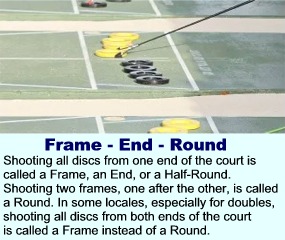
1. The head or the foot of a court. 2. The shooting of all discs from one end during a game. 3. (Australian) A complete half of the frames to be played in a frame game wherein the players switch colors at the halfway point.
Expert
A player who has advanced their player status within their state (e.g., Ohio; Texas) from Amateur to Expert after achieving the necessary prerequisites, such as accumulating a sufficient number of Move-Up Points by placing in state shuffleboard association tournaments that award such points to Amateur players, or placing in particular state or national tournaments within the state.
Exposed
(of a live disc) On the scoring diagram but uncovered or only partially covered.
Source & scope
This online Dictionary is built from CourtShuffleboard.com’s prepared court-shuffleboard terminology dataset. It preserves source-specific and regional meanings where they matter and can be expanded carefully as additional terms are reviewed.
For current playing rules, use the governing rules for the organization, event, or location where you are playing.