Learn, Improve, Connect: Your Modern Shuffleboard Hub
Learn, Improve, Connect: Your Modern Shuffleboard Hub
TERMS • DEFINITIONS • CONTEXT
Unabridged Shuffleboard Dictionary
Search and browse court-shuffleboard terminology, including playing terms, strategy language, equipment, court features, tournament terminology, organizations, and regional usage.
Terminology is not always universal
Some court-shuffleboard terms vary by organization, country, state, club, or historical source. Definitions preserve those distinctions where they are part of the source material. A Dictionary definition is not automatically a current governing rule.
Search or browse the Dictionary
Use the search box or alphabetical index below to find a term.
A frame-game format wherein for the first round (in singles) or for the first two rounds (in doubles) only scoring discs in the 10 count, for the second round(s) only scoring discs in an 8 count, and for the third round(s) only scoring discs in a 7 count. This sequence either repeats or reverses for any subsequent rounds. Scoring discs in the 10-Off count either always as minus 10 points for the color (e.g., a yellow disc in the 10-Off counts as minus 10 for yellow), or always as plus 10 points for the opposite color (e.g., a yellow disc in the 10-Off counts as plus 10 for black).
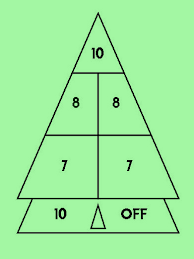
The scoring area inside the lines of the scoring diagram located between the 7s and the standing area. Scoring discs wholly within the 10-Off, including touching or on the separation triangle, count as minus ten points or, in some game formats, as plus ten points. Syn: -10, KITCHEN, SOUP.
The horizontal line of the scoring diagram separating the 10 scoring area from the 8 scoring areas. Syn: 8/10 LINE.
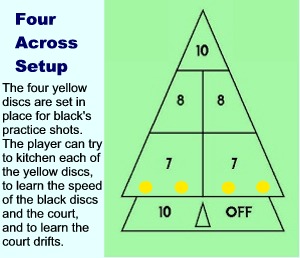
4-Across (Four-Across)
A setup for a set of four practice discs by placing four target discs, one each in or near each of the four corners of the deep sevens at the receiving end. A disc is placed by the outside deep corner of each seven and one by each deep corner formed by the centerline and the 7/10 line; or the four discs are placed in or near even spacing across the deep sevens. The player at the receiving end may use the end of their stick to represent the first target disc if there are no other discs yet at that end to use for the setup, and then follow by using the shot discs for the next three setup positions.
A game format wherein two competing players shoot from opposite ends, highest score at the end of any round in which one or both players have a score of 51 or more wins. If no disc is scoring in the 10-Off at the end of any frame, the frame counts as minus 10 points total for the shooting player regardless of any other scoring discs. Otherwise, for the frame 10s count as 10 points, 8s as 2 points, 7s as 1 point, the first 10-Off as plus 10, and any additional 10-Offs as minus 10. Any cue disc that doesn't reach the deadline or travels through the 10-Off without touching any other disc counts as minus 5. A cue disc that lands in the 10-Off without touching any other live disc first is a dead disc and is removed immediately from the board unless there is no other live disc on the board that is not in the 10-Off.
Either of the two scoring areas inside the lines of the scoring diagram that are between an 8 and the 10-Off. Scoring discs wholly within a 7 count as seven points. Syn: SEVEN.
7/10-Off Line; 10-Off/7 Line; 7/Kitchen Line
The horizontal line of the scoring diagram separating the 7 scoring areas from the 10-Off scoring area. Syn: 7/KITCHEN-LINE.
7/7 Line
The portion of the centerline that separates the two 7 scoring areas.
8 (Eight)
Either of the two scoring areas inside the lines of the scoring diagram that are between the 10 and a 7. Scoring discs wholly within an 8 count as eight points. Syn: EIGHT.
8/7 Line; 7/8 Line
The horizontal line of the scoring diagram separating the 8 scoring areas from the 7 scoring areas.
The portion of the centerline that separates the two 8 scoring areas.
A
A
Amateur: A designation on Florida tournament schedules, part of the tournament number, indicating a tournament is a statewide Amateur-only event, awarding Move-Up Points to Amateurs. Such a tournament appears both on the FSA Amateur Tournament Schedule and the schedule of the District where the tournament takes place. (Example: "A01" is the first statewide open event of the season for a District.)
ABS
Brazil Shuffleboard Association (Associação Brasileira de Shuffleboard): https://shuffleboard-brasil.webnode.page/
Have the mathematical advantage in scores in the expectation to win the game. The math takes into account current recorded scores on the scoreboard, any currently scoring discs, and the expectation that for the remainder of the game, every player scores their hammer shots but no additional discs.
Aim
The positioning before a shot of the cue, the cue disc and the body by a player to direct the cue disc to a target.
Aim: Pivot your whole body to point in the direction of where you want the disc to go, letting the cue, your arm, and your hand follow the pivot. Your feet and shoulders should point squarely at your aiming spot.
Aiming Spot
The location on the board or on a live disc at which a player aims the cue disc to hit its target. The aiming spot usually differs somewhat from the location of the target itself to compensate for variations in the cue disc's path of movement down the court due to drift or other factors.
Alley
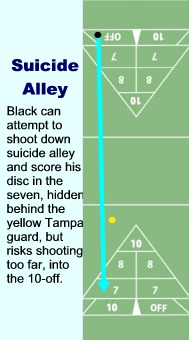
1. A channel along either side of the court that extends the whole length of the court. Alleys are usually two feet wide. 2. SUICIDE ALLEY.
1. A player who plays in state shuffleboard association tournaments but has not yet accumulated the required Move-Up Points or other prerequisites to advance beyond Amateur status within their state (such as Florida, Ohio, or Texas). 2. A designation for tournaments that allow Amateur players only. Syn: AM.
Area: A designation on Florida tournament schedules, part of the tournament number, indicating a tournament is a District-only event, not awarding Move-Up Points to Amateurs. Such a tournament appears only on the schedule of the District where the tournament takes place. (Example: "AR01" is the first such District-only event of the season for a District.)
An appealing board opportunity that promises extra reward and can tempt a player away from the planned Immediate Goal. It may arise accidentally or be deliberately created by an opponent.
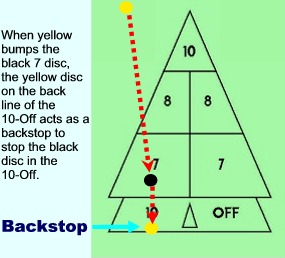
1. A disc on the scoring diagram that can be utilized as an aid to stop a moving disc at a position in front of it when struck by the moving disc. Often refers to a liner that, when struck head-on, will leave the moving disc stopped in a scoring position. 2. A low barrier at the front and rear edges of the court, in front of the player benches, that serves to stop or deflect any moving discs that reach the edge. Often composed of or reinforced with a shock-absorbent material, such as a sand-filled 2" pool drain hose, to prevent discs from rebounding to the board.
Bait
1. KITCHEN BAIT. 2. Tempt one's opponent by shooting a disc onto the board without a guard, to act as kitchen bait.
Ball's Law
"When you are ahead, everything goes right. When you are behind, nothing goes right." Originates from Mr. & Mrs. Richard Ball, the first to bring shuffleboard to land from cruise ships, in 1913.
Balpeen
A positive score of less than 7 on one’s hammer.
Bank
A fun game variation which requires discs to bounce off wooden bumpers placed along the alleys, from the 7/8 line at one end to 7/8 line at the other, for a scoring disc to count. Originally played on three of the terrazzo courts at St. Petersburg Shuffleboard Club in the 1960s.
Barricade
Stop one’s opponent from scoring the hammer by building a spread of three or more discs across the court above the scoring triangle, leaving little or no openings for a direct shot to score. Syn: BLOCK OUT, BUILD A WALL, CLUTTER THE TOP COURT.
Baseline
1. The horizontal line that separates the scoring diagram from the standing area. Syn: BACK LINE. 2. The imaginary horizontal line that includes the baseline (def. 1) and extends through the alleys on the two sides of the court. Syn: FOUL LINE.
Beader
A device for spreading beads on a court.
Beads
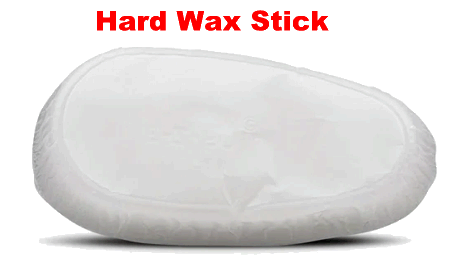
Fine glass or plastic globules that are sprinkled on the playing area of a court to reduce the friction between the bottoms of moving discs and the court surface. Syn: GLASS, SAND, WAX.
Beads, Dry
Beads that have not been treated to make them wind-resistant.
Beads, Glass
Beads made from glass.
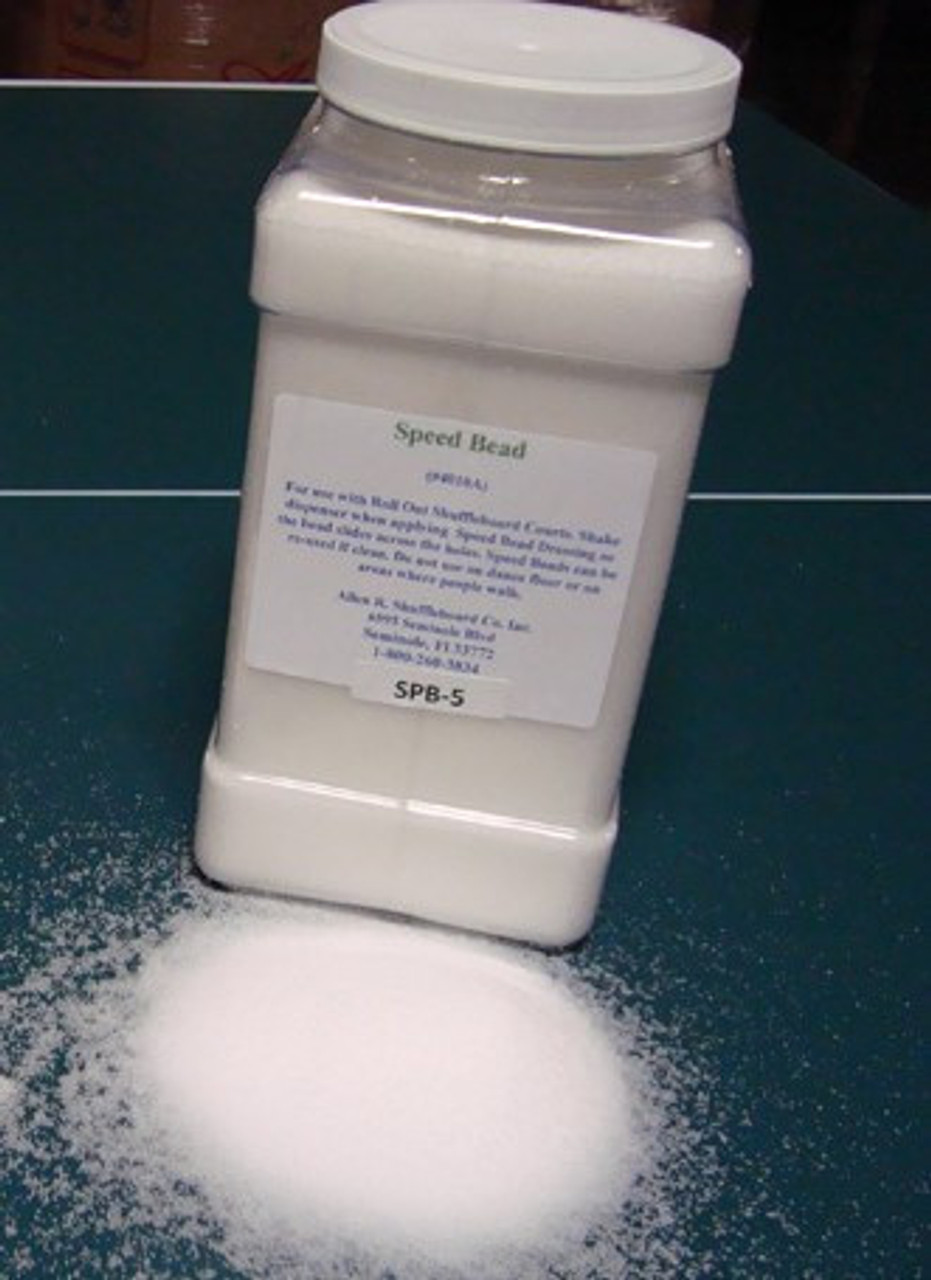
Beads, Speed
Beads made from plastic, for rollout courts.
Beads, Wet
Beads that have been treated to make them wind-resistant when spread on a court. Beads can be treated by coating with a small amount of silicone, glycerin, or glycerin-containing products (e.g., dish soap; Tire Shine). Syn: WIND-RESISTANT BEADS.
1. A position that is further away from the end of the shooters than a particular disc or location on the board. 2. Have a mathematical disadvantage in scores in the expectation to lose the game. The math takes into account current recorded scores on the scoreboard, any currently scoring discs, and the expectation that for the remainder of the game, every player scores their hammer shots but no additional discs.
1. The darker of the two colors of a set of discs. 2. The player who shoots this color discs. 3. The side of the court where this color discs are placed in the starting area.
Black Court
A court that favors the player or team shooting the black discs due to the drift of the court, aiding the black shooter to place a scoring disc hidden behind a Tampa or St Pete. Usually, a black court has more drift from the black side towards the yellow side (but if that drift is too strong, such a court might favor yellow instead).
Block
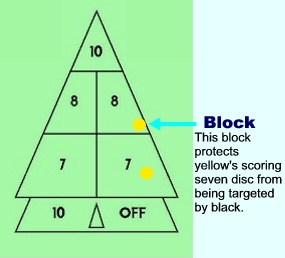
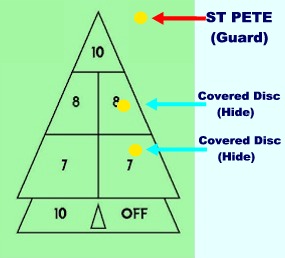
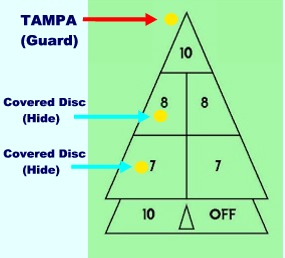
1. Make a shot that causes a disc to stop in a position obstructing one's opponent from targeting a particular live disc or section of the board. Syn: COVER, GUARD, HIDE. 2. A disc stopped in such a position. Syn: COVER, GUARD, HEAD BLOCK, HIDE, LID. 3. DISC.
Put up one or more blocks to limit the shots available to one's opponent for making a scoring disc.
Blocking Game
A game strategy that emphasizes the use of blocks to minimize the opponent's opportunities to make scoring discs, as contrasted with a clearing game or playing kitchen.
Board
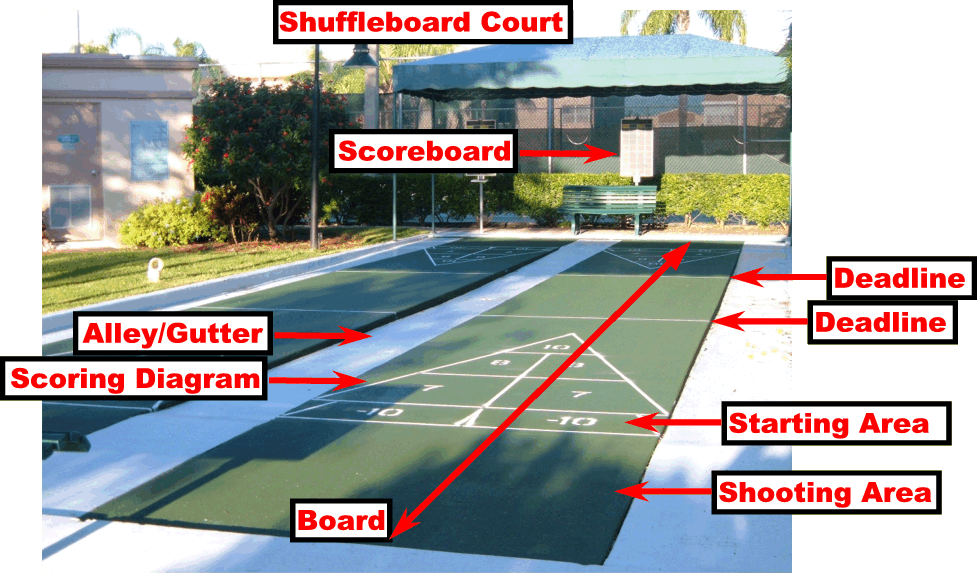
1. All the playing surface of the court other than the standing areas, from the baseline at one end to the baseline at the other end. (Example: "The disc was removed from the board as it did not reach the deadline.") Also PLAYING AREA. 2. The portion of the court at the end opposite from the shooters that includes all areas where a stopped disc can be a live disc. (Example: "He cleared all the discs from the board.") 3. SCORING DIAGRAM. (Example: "Put up a guard before going on the board.")
Board Player
A player who favors shooting discs into the scoring areas rather than putting up guards or clearing the opponent's guards.
Bracket
1. Step ranges in game score, such as the "ten bracket" is a score from 10 to 19, the "twenty bracket" is a score from 20 to 29, etc. In the “Modular System” developed by the author Wilbur L. Estes, the scores -5, 11, 27, 43, and 59 are the lower limits of 16-point brackets, used in any 75-point doubles game for calculating which team is currently in the lead to determine the best strategy going forward (similarly, 8-point brackets are used instead for singles games). 2. In tournament play, the diagram for recording the match assignments, wins, losses, and advancements in ranking of the participating players or teams. A tournament may have more than one bracket, most commonly a Main Event Bracket that tracks the winners of the first match of the tournament and a Consolation Bracket that separately tracks the losers of the first match of the tournament, each bracket showing its own ranking of players or teams through the end of the tournament. 3. The pair of lines on a tournament chart that shows the two opposing players or teams for a round.
Buck Fever
The tendency to shoot the hammer short of its target due to the mental pressure of scoring one's hammer shot.
An automatic advancement of a player or team to the second round (def. 4) of a tournament without playing a match for the first round. A BYE occurs when there is no opponent player or team assigned to one of the two lines of a tournament bracket (def. 3), giving the player or team on the other line no opponent for that first round.
C
Call
1. (call a disc) View a live disc and make a declaration whether or not it is a scoring disc. 2. (call the score) At the end of a frame, total up the scoring discs for each color and call out to the scorekeeper and players the total score for each color for that frame. 3. (call to court) An announcement by a tournament official reading out the names of players and their assigned court, to prompt them to proceed to the court and begin their match play. Calls to a court are usually timed in 5-minute intervals until all called players arrive at the court.
Call, First
1. The initial call (def. 1) of a close disc. In non-walking singles, first call is made by the referee or, if there is no referee, by a player or the pusher at the receiving end. In walking singles, if there is no referee and the players disagree on a close disc, either one may ask a player from another court to make a first call. In doubles, if there is no referee and the players at the receiving end disagree on a close disc, either may ask a player from another court to make a first call. 2. The initial call (def. 3) of players to a court.
Call, Second
1. A call (def. 1) made after a first call is made. If a referee made first call, either player in singles, or either player at the receiving end in doubles, may challenge the first call, and second call is made by a different referee. In non-walking singles, if there is no referee either player may challenge the first call and ask a player from another court to make a second call. In walking singles, if there is no referee, either player may challenge the first call and ask a player from another court, other than the player that made first call, to make a second call. In doubles, if there is no referee either player at the receiving end may challenge a first call and ask a player from another court, other than the player that made first call, to make a second call. 2. The second call (def. 3) of players to a court.
Call, Third
1. A call (def. 1) made when first call and second call disagree. If a referee made the second call, third call is made by a head referee, or in a tournament by the Tournament Director or an Assistant to the Tournament Director. If there is no referee, third call is made by a player from another court, other than the players that made the first and second calls, or in a tournament by the Tournament Director or an Assistant to the Tournament Director. Third call is always final. 2. The third call (def. 3) of players to a court. After third call, failure to arrive at the court within the allowed amount of time is usually subject to forfeiture of the match.
1. A shot where the cue disc hits a target disc and then moves in another direction to stop in an intended location on the board or to strike one or more other target discs. 2. BUMP UP.
Cash Line
CENTERLINE. Named after the Johnny Cash song “I Walk the Line.”
The tournament official that conducts player draws for line number or court assignment, and maintains the tournament charts.
Charting
Notating and using drift charts.
Chase a Disc
Attempt to clear a hidden or partially hidden scoring disc. Often denotes a strategic choice to go after the scoring disc rather than some other, possibly more beneficial, shot such as scoring one's own disc.
Chatter
The noise and action of a shot disc as it moves over a roughened or unlevel area of the court, causing the moving disc to shake and rumble. Syn: FLUTTER, RATTLE.
Chip
An unintentional narrow touch in passing by the cue disc of a side of a live disc, thus diverting the cue disc partially or fully from its intended destination. Syn: CLICK, HAVE A WRECK, NICK, WRECK.
A description of the board when no live discs remain on the board during the play of an end. An educated player who is ahead and has the hammer will most often, as an ideal game strategy, keep the board clean by clearing with their first three discs, and then score their hammer.
1. Shoot the cue disc such that one or more target discs as well as the cue disc are moved off the board. 2. Strike one or more target discs, moving them off the board.
Clear the Board
Shoot the cue disc in a manner that leaves no live discs on the board. This is done to remove all discs from the board to prevent one's opponent from using such discs to their advantage. Syn: CLEAN THE BOARD, KEEP THE WOMEN AND CHILDREN OFF THE STREETS.
Clearing Game
A game strategy that emphasizes clearing the board and scoring one's hammers to maximize one's point lead, as contrasted with a blocking game or playing kitchen.
Clearwater
A disc in a Tampa position on the opposite side of the apex from the shooter. This makes a useful Tampa guard for the opponent rather than the shooter.
Click
CHIP. Often used as an exclamation, usually while the cue disc is in motion, to note or emphasize the unintentional mistake.
Close Disc
A disc that has stopped inside the scoring diagram close enough to one or more lines to make it difficult to determine without close examination if it is a scoring disc.
Closed
1. (In Ohio) A tournament or division of a tournament that is restricted to players aged 65 or older. 2. (in Texas) A designation for a mobile home park or club that requires both players of their doubles teams to be from that same mobile home park or club. 3. (in Florida) A tournament that is restricted to players that reside within the District where the host club is located.
Canadian National Shuffleboard Association: https://theshufflersnews.wordpress.com/
Coaching
A signal or verbal hint intended to help another player in their game. Coaching one's partner in an official tournament during a game is usually subject to penalty.
Color
1. The color of the discs that a player or team is shooting. Sometimes the actual disc color varies from the standard yellow and black colors, but 'yellow' and 'black' are still the designated colors, yellow the lighter of the two actual disc colors. 2. The player or team shooting that color. 3. The side of the court where that color discs are shot from.
Color Bar
A fixed or rotating rectangular bar along one side of the scoreboard, striped in alternating colors, yellow and black, that indicate which color is out for each half-round of a game. A rotating color bar has different patterns on each side to match the play pattern of various format games, such as a side with alternating yellow and black for a typical singles game and a different side with alternating two half-frames of yellow followed by two half-frames of black for a typical doubles game. The appropriate side of the rotating color bar should be turned to the front view of the scoreboard, to be used for the duration of the current game or match. Syn: COLOR INDICATOR.
The color that is out for an end. (Example: "Yellow has the color lead when play continues after the rain stops.")
Colors
1. A variation of the mingle singles tournament format wherein the random draw for court, end, and color assignment for each player is done only once, at the start of the tournament. The players continue to play the same end and color for all games but change court each game by moving to the next court over, or if moving from the first or last of the courts, wrapping around to the furthest court (e.g., all players on Yellow move one court to their left and all players on Black move one court to their right). For each game, the total number of wins by the players of each of the two colors is recorded and accumulated. The tournament winners are all the players who played the color with the highest total game wins for the tournament. 2. MINGLE SINGLES.
Combination
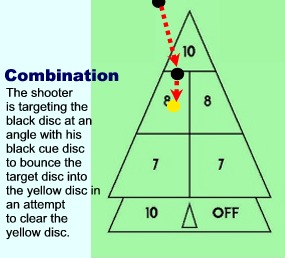
1. A shot where the cue disc strikes one or more target discs that in turn strike one or more other target discs that may also in turn strike additional target discs. Used to make covered scoring disc(s) or to clear the opponent's covered disc(s), or both. 2. CAROM 3. A shot that combines 1. and 2.
Coming in Hot
Said by the shooter before a shot to warn the players at the receiving end that the shot will be fast, and they should take care that they don't get injured by a fast-moving disc.
1. The complete area for play of a game, including the board, standing areas, alleys, benches, and scoreboard. 2. In tournament rules, the court includes the board (def. 1) plus a rectangular area at each end defined by the baseline (def. 2), an imaginary line even with the back of the bench, and the farthest side of each adjoining alley.
Court Master
The tournament official in charge of preparing and maintaining the courts before and during play. Duties include such things as court sweeping, court beading, distribution of erasers and pens or chalk for the scoreboards, disc preparation and lighting.
Court Scorer
A tournament official assigned to a court to act as scorekeeper.
Court Shuffleboard
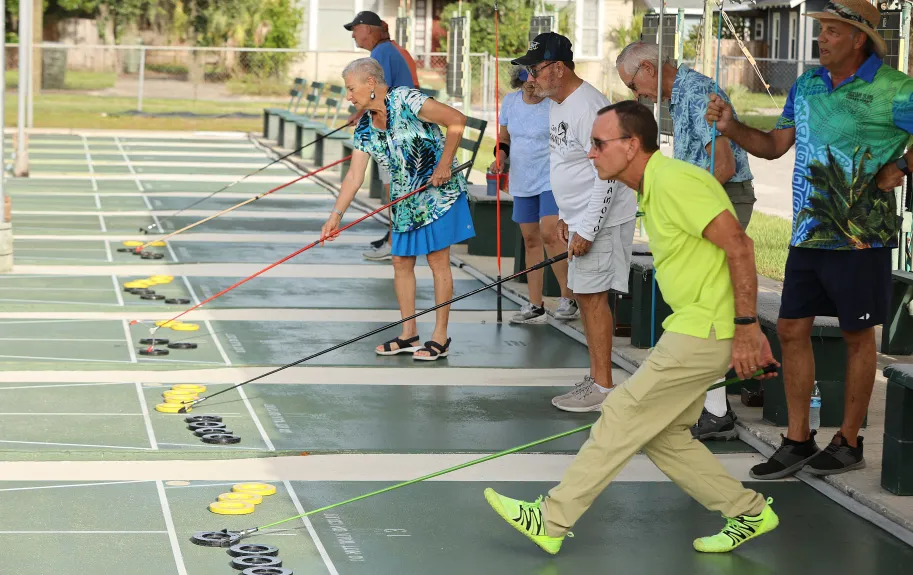
A game played by two or more players who each attempt to outscore their opponent(s) by using a cue to propel discs down a court, usually concrete, into the triangular scoring diagram painted on the court at the opposite end. Court shuffleboard evolved from table shuffleboard, a similar game played on a tabletop. Syn: DECK SHUFFLEBOARD, FLOOR SHUFFLEBOARD, OUTDOOR SHUFFLEBOARD, SHUFFLEBOARD.
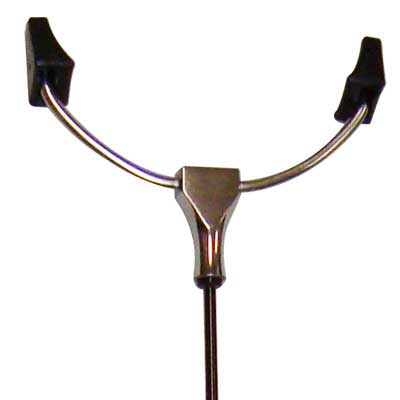
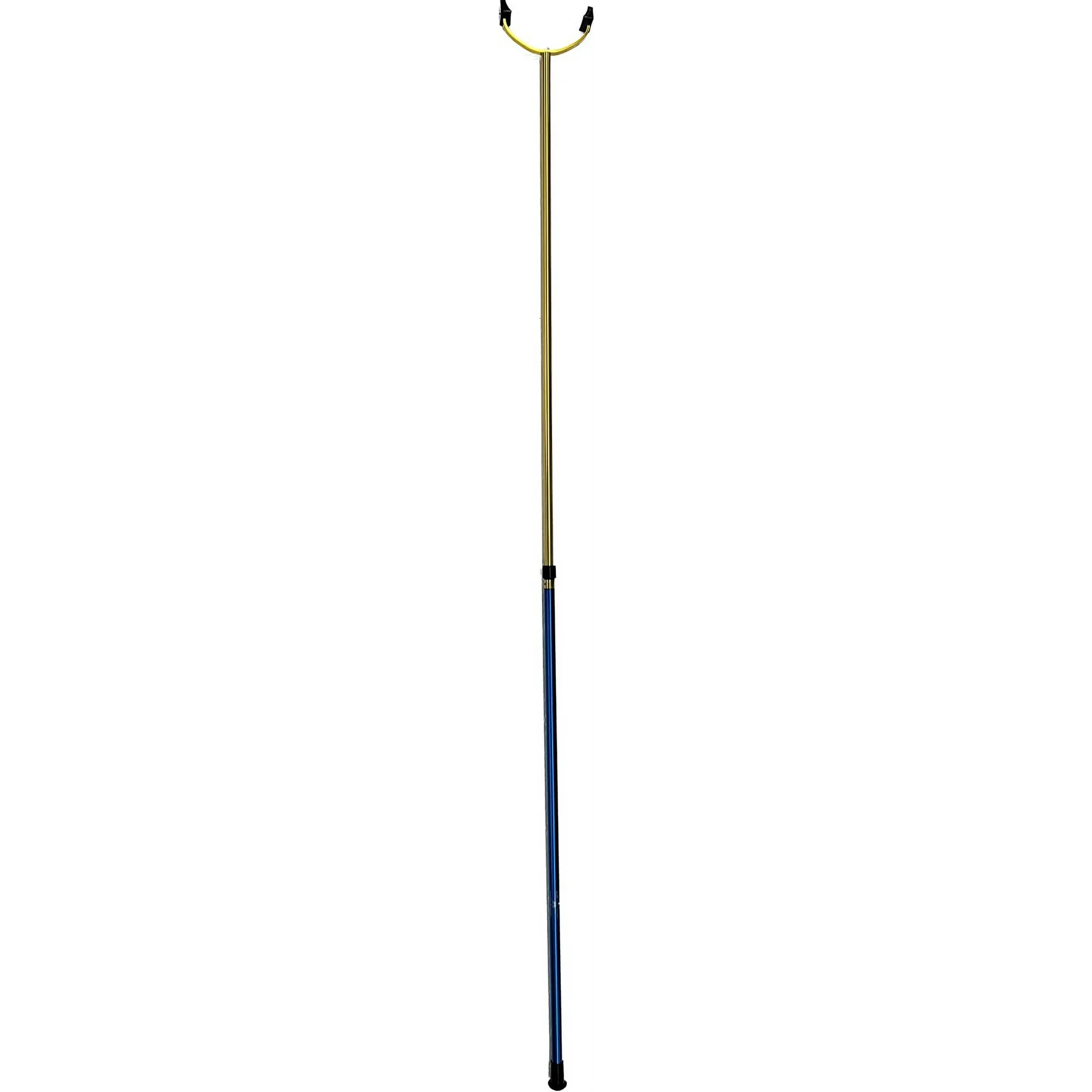
A straight uniform or tapered rod with an integrated or attached two-pronged head, used to propel discs down the court. A cue may be up to 6'3" in length per regulations. Syn: CUE STICK, STICK, TANG.
Cue Disc
The disc a player is currently shooting. Syn: SHOOTING DISC.
A cue with a tapered and somewhat flexible shaft. The term is mostly used for graphite cues, but can apply to cues of other materials, such as bamboo or fiberglass.
Cue, Carbon Fiber
A cue with a shaft constructed of carbon fiber.
Cue, Composite
A cue with a shaft of graphite (less rigid) or carbon fiber (more rigid). Composite cues are designed for tournament competition, with lightweight tapered shafts which come in 1, 2, 3 or 4-piece versions.
Cue, Continental
A recreational cue with a continental head.
Cue, Glider
A cue with a glider head. Syn: RIDER CUE.
Cue, Graphite
A cue with a shaft constructed of graphite.
Cue, Multi-Piece
A cue constructed to be disassembled into multiple pieces for transport or storage.
Cue, Recreational
A cue with a uniform shaft, usually one-piece aluminum, and a recreational-style head (e.g., continental; resort; Tuffy), mainly intended for use at home, resorts, vacation spots or community centers, for recreational play. Syn: CLUB.
A cue with a shaft that can be nested for transport or storage, then extended for play. The cue length is adjustable as the shaft can be extended either partially or fully, making it appropriate for both children and adults.
Cue, Tournament
A cue with advanced features such as swivel runners, multi-piece composite shaft, light-weight design and/or chameleon head, intended for use at competitive events.
District: A designation on Florida tournament schedules, part of the tournament number, indicating a tournament is a District-only event, awarding Move-Up Points to Amateurs. Such a tournament appears only on the schedule of the District where the tournament takes place. (Example: "D01" is the first District-only event of the season that awards Move-Up Points.)
DBLS
DOUBLES (def. 2). An abbreviation used on tournament schedules.
DBLS M/L
Doubles Men/Ladies: An abbreviation used on tournament schedules to designate a doubles event that has two separate divisions, one for men and one for women.
Dead Disc
1. A disc that is out of play after a shot because it has left the board, touched any part of an alley or portion of the edge of the court other than the playing surface, touched any person or object outside of the board, or stopped in front of and not touching the deadline at the receiving end of the court. Also, a live disc may be declared dead as part of certain tournament rules violations or penalties. A dead disc is immediately removed from the board before play continues. 2. A live disc that is in a position that makes it mostly useless as a target disc for a carom or combination shot. 3. A live disc that normally is not considered useful as a target disc to be kitchened due to its location on the board, distance from the kitchen, or angle away from the kitchen. 4. LINER.
Dead Zone
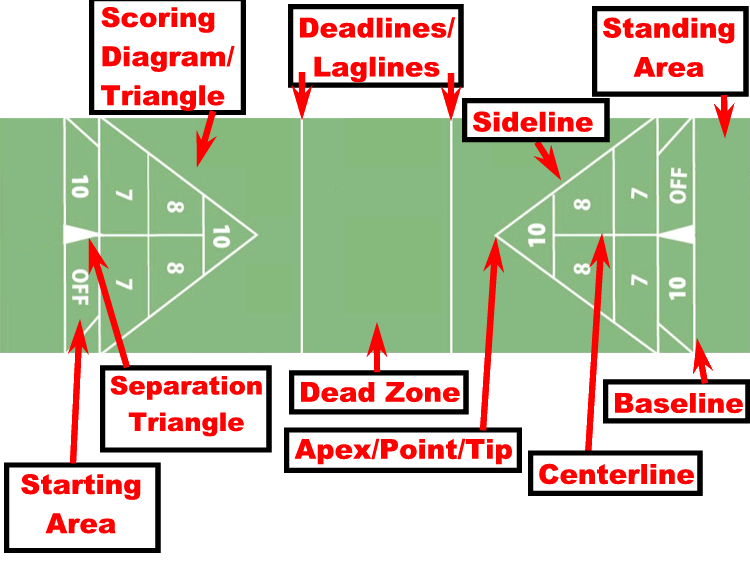
The area of the court between the two deadlines. Syn: NO MAN'S LAND.
Deadline
Each of the two horizontal painted lines on the court, one three feet in front of each of the two scoring diagrams. A cue disc that stops on the shooter's side of the furthest deadline, not touching the deadline, after being shot is a dead disc (even if it has struck another disc). Syn: HOG LINE, LAGLINE.
Deck Shuffleboard
COURT SHUFFLEBOARD. || From the early word usage for the game's original form, when it was played on the deck of a military ship or ocean liner.
Deep
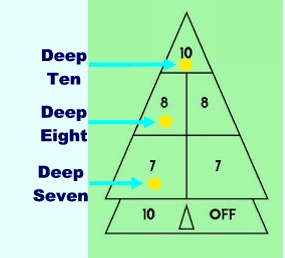
1. (of a scoring disc) Close to but not touching the line directly behind. (Example: "A deep 7 may get bumped into the kitchen.") 2. (of a guard) Behind its usual or ideal position. (Example: "A deep St. Pete blocks a smaller area of the board.") Syn: LOW.
Delivery
The manner and execution of the forward motions a shot, consisting of Steps, Swing and Follow-Through.
A concrete court that has been made extremely smooth by the use of a diamond grinding machine and polished with diamond pads.
Disc
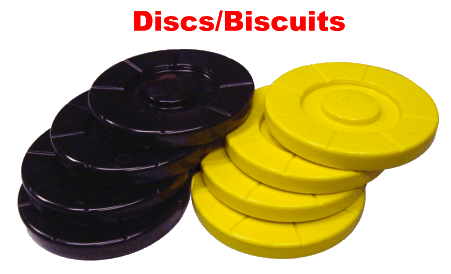
The disk used in shuffleboard for shooting and scoring. A set consists of eight discs, four each of two different colors, usually yellow and black, white and black, or red and black. New discs are manufactured, usually of molded plastic, to be 6 inches in diameter, 9/16 to 1 inch in thickness, and 15 ounces in weight. Syn: BISCUIT, BLOCK, PUCK, WEIGHT.
District
A section of a state, as determined by the state's official shuffleboard association, to which member clubs belong. (Arizona has 5; California has 13, many inactive; Florida has 7.)
District Amateur
(in Florida) A player is conferred the status of District Amateur upon playing in their first FSA tournament.
1. A separate event for a class of players in a tournament. (Example: "Only women are eligible to play in the Ladies Division." 2. A separate class of players. (Example: "The winners in each of the two divisions, Amateur and Expert, will receive award pins.")
Double
Strike a target disc in a manner that makes both the cue disc and another disc of the same color (often a liner) into scoring discs.
Double Clutching
(in California) Striking the cue disc with the head of the cue twice during a shot. Use of double clutching in a tournament can be subject to penalty.
Double Hide
Two guards, either side by side or one in front of the other, covering a scoring disc.
Double-Soup
Having two discs in the 10-Off at once.
Doubles
1. A game wherein a team of two players competes against a team of two other players. 2. A tournament format wherein teams of two players compete against other teams of two players. Syn: DBLS.
Doubling Disc
A disc on the board (usually a liner) that is in a favorable position to be doubled.
Downhill
In the direction of the drift.
Draw
A random selection prior to the start of a tournament of the line number assignments, the court assignments for first matches, and/or the pairings of two players for each doubles team.
Draw Doubles
1. A doubles game wherein a draw selects the pairings of two players for each doubles team. 2. A doubles tournament format wherein a draw selects the pairings of two players for each doubles team before the start of the tournament.
Draw Master
The tournament official that prepares and conducts the draw.
Dress a Court
Sprinkle beads on the surface of the entire playing area of a court.
Dressing
Beads sprinkled on the surface of a court.
Drift
1. Deviation in the movement of a disc off a straight line as it travels down the court due to variation, usually imperceptible to the eye, in the playing surface of the court from a flat horizontal plane. 2. The characteristic of a court that has playing surface variations causing such deviations. (Example: "The court we played on has a lot of drift.")
Drift Chart; Drift Card
A handheld representation, on paper or other writing material, of a board, its scoring diagram, and positions for discs, upon which a player makes notations about the characteristics of the discs and court. Used during a game, mainly by advanced players for tournament play, as a memory aid for the aim of the shot to account for drifts and other anomalies of the court and/or in the selection of a cue disc for a shot according to the disc's play characteristics (such as speed). Syn: ROAD MAP.
Drive By
A shot where the cue disc passes to the side of the intended target disc without touching and continues well beyond, usually through the kitchen and off the board.
Beads that have been affixed evenly and permanently into the top surface layer of the board of a court so that there is no need to sprinkle beads on each time before play. Syn: PERMANENT BEADS, SEALED-IN BEADS. The process of embedding beads was invented and developed by Christopher Branda in 1965 at Parris Trailer Park, Ormand Beach, Florida.
End
1. The head or the foot of a court. 2. The shooting of all discs from one end during a game. 3. (Australian) A complete half of the frames to be played in a frame game wherein the players switch colors at the halfway point.
Expert
A player who has advanced their player status within their state (e.g., Ohio; Texas) from Amateur to Expert after achieving the necessary prerequisites, such as accumulating a sufficient number of Move-Up Points by placing in state shuffleboard association tournaments that award such points to Amateur players, or placing in particular state or national tournaments within the state.
Exposed
(of a live disc) On the scoring diagram but uncovered or only partially covered.
F
Fast
1. (of a court) Requiring less force than usual to propel discs from one end to the other due to the condition of the court. 2. (of a disc) Requiring less propelling force than usual to slide down the court due to the condition of the disc.
Fat-7
A scoring disc lying centered in the 7.
Fat-8
A scoring disc lying centered in the 8.
Fill In
1. Shoot the cue disc to a position that obstructs one's opponent from hiding a disc behind an existing guard. Most often refers to the placement of a Tampa to block the use of a St. Pete guard by the opponent. Syn: CHOKE, COUNTER BLOCK. 2. A disc placed in such a position. Syn: COUNTER BLOCK.
The final motion forward of the hand, arm, and cue stick at the end of the swing for a shot, to maintain the course of the cue and cue disc.
Follow-Through: Always follow through on your swing all the way out to the full extension of your arm, whether you are swinging fast, medium, or slow. Do not lift the cue up off the board at least until the disc has fully left the head of the cue – if you do, you are gripping too tightly. Sometimes with the light grip, the cue will slip out of your hand at the end of a fast shot – this is acceptable.
Foot
The end of the court that doesn't have the scoreboard.
Fort Knox
Multiple guards covering a scoring disc to make it very difficult or impossible to clear the disc with a direct or combination shot. Syn: LOCKING COVER.
Foul Line
BASELINE (def. 2). So named because fouling the line (stepping on or over it) while shooting is a violation of official rules of play.
Fr.
Frames: An abbreviation used on tournament schedules. Example: "75 pts/16 Fr." means that the tournament games are played to 75 points or 16 frames.
Frame
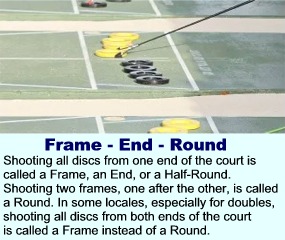
1. The portion of a game wherein players shoot all the discs from one end, and then the score totals for those discs are posted on the scoreboard. Also, HALF-FRAME, HALF-ROUND. 2. (in non-walking singles) In some locales (e.g., Texas), the portion of a game wherein players shoot all the discs from one end and the score totals for those discs are posted on the scoreboard, and then complete the same at the other end for those singles players. Syn: ROUND. 3. (in doubles) In some locales (e.g., California; Texas), ROUND (def. 3). || Usage of the terms Frame and Round varies based on local, regional or state rules and customs. Each term may mean either completing one end or two ends of play, whether singles or doubles, depending on where you are playing. Players must clarify the local meaning by consulting local players, officials, or written rules.
Frame Game
A game format wherein the winner is determined by the highest total recorded score at the end of a pre-determined number of frames.
Free Ride
A disc that lies on the deadline protruding into the dead zone and can be targeted for a bump up at kitchen speed in an attempt to push it forward into the kitchen, with little risk of the cue disc becoming a guard for the opponent (if the cue disc sticks it will likely stop short of the deadline, leaving it as a dead disc to be immediately removed from the board).
A seasonal schedule of all official FSA statewide Amateur-only tournaments, awarding Move-Up Points to Amateurs, along with special events restricted to only Amateur players that qualify (e.g., Tournament of Champions).
FSA Open Tournament Schedule
A seasonal schedule of all official FSA statewide open tournaments, awarding Move-Up Points to Amateurs and Masters Points to Pros, along with special events restricted to only Pro players that qualify (e.g., Masters; Tournament of Champions).
Fun Game
A game outside of tournament competition, played for fun or training. Syn: FRIENDLY GAME.
G
Game
A scoring disc that will give the player or partner team the number of points needed to win in a points game if it remains scoring at the end of the current frame.
Game On The Board
A player or partner team currently has the scoring disc(s) needed to win in a points game if the disc(s) remains scoring at the end of the current frame.
Game Point Rule
Estes' strategic rule for deciding whether to remove an opponent's game-winning disc or use the hammer to try to end the game. The recommendation differs between head and foot and is strategy from the Modular System, not a current governing rule.
Gandy
A guard that is centered in front of the apex of the scoring diagram.
Gauntlet
An opening between two guards on the same side of the board through which the cue disc can be shot without contacting either guard.
Glance
A shot where the cue disc strikes an edge of a target disc such that the cue disc alters course to stop in an intended favorable position on the board. Most often used to make the cue disc a hidden scoring disc. Syn: WICK.
Shoot the cue disc directly onto the scoring diagram as an unhidden scoring disc.
Good
(of a disc) On the board as a scoring disc.
Good Out
An expression used to compliment a player upon making a shot that successfully clears that player's disc from the kitchen.
Grip
1. A handhold for the tip end of a cue that aids in maintaining hold when shooting. 2. The manner in which a player holds the cue for a shot.
Grip: Rest the end of the cue lightly on two or three fingers, and steady it with your thumb. Don’t grip tightly. You can place your ring or pinky finger behind the end of the cue to prevent the cue from slipping backwards when you push forward.
Grip, Bicycle
A cue similar in shape to bicycle handlebar grips, much longer than the standard cue cane grip. The grip diameters for shuffleboard cues are 5/8" or 3/4" (standard grips for bicycles are 7/8").
Grip, Rubber
A grip constructed of rubber, covering a small length of the cue shaft end.
GSA
German Shuffleboard Association: https://www.shuffleboarder.de/
Guard
1. A disc in a position on the board such that it would interfere with an opponent's attempt to target a disc that is behind it. The St. Pete and the Tampa are generally considered the best guard positions for hiding scoring discs. 2. BLOCK (defs. 1 & 2).
Gutter
The depressed channel of the alley. Most regulation courts have alleys that slope downward below the level of the court playing surface beginning at the baseline at each end, to a depth of four or more inches at mid-court, to catch shot discs that land in the alley and to channel away rainwater.
A list of shuffleboard participants maintained by a club, association or organization of those that have been conferred induction into the Hall of Fame in recognition of shuffleboard achievements such as a milestone of accumulated lifetime Masters Points, outstanding tournament performance records, leadership contributions, promotion of shuffleboard and/or other exceptional contributions to the sport. A Hall of Fame typically has a physical or virtual location, or both, featuring the names, pictures and biographical information of the inductees, as well as other historical information and artifacts related to shuffleboard.
Hammer
The last disc to be shot in an end (def 2.).
Hard
(of a shot) Very fast.
Hard Clear
A shot where the cue disc is propelled fast by the shooter to clear one or more discs from the board, usually with the intent also to clear the cue disc.
Hard Shot
A shot where the cue disc or a disc cleared by it has enough moving force that it could cause injury to a player or spectator. Use of hard shooting in a tournament can be subject to penalty. Hard shooting can include the cue disc or a target disc traveling over and beyond the backstop at the rear of the receiving end of the court (Ohio), beyond the standing area of an adjacent court (Ohio), or predictably and consistently onto the standing areas of adjacent courts (Texas).
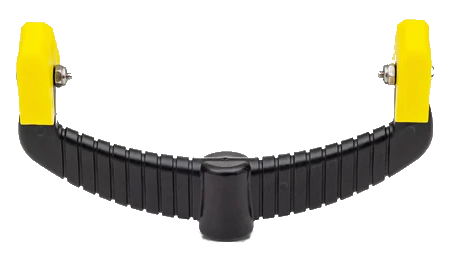
A metal cue head, 5 1/2 inches wide, that bolts to the cue shaft, with replaceable swivel runners.
Head, Bumblebee
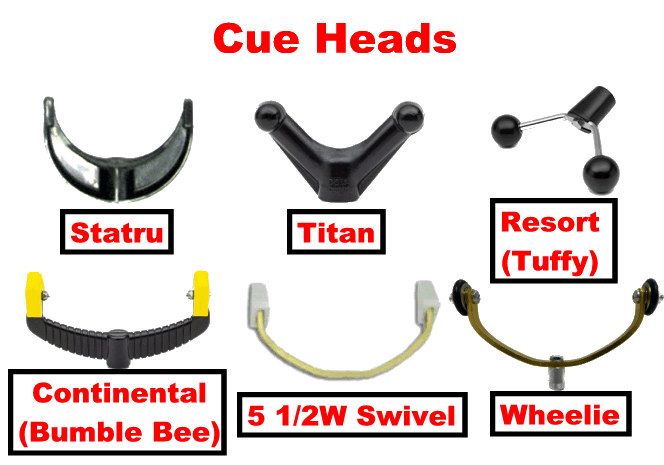
A black continental cue head with yellow swivel runners. The color combination resembles that of a bumblebee.
Head, Chameleon
A swivel cue head that has a threaded hole in the center that accepts various-sized screw-in weights, making the head weight-adjustable.
Head, Continental
A molded-plastic corrugated cue head with replaceable swivel runners. (For recreational cues)
Head, Glider
A swivel cue head featuring a plastic crosspiece that spans the head from one prong to the other, replacing the swivel runners. The crosspiece rests atop the rear portion of the cue disc. Designed to avoid contact with the court by any portion of the cue when shooting.
Head, Resort
A Tuffy cue head bolted to a cue mounting cap. (For recreational cues)
Head, Statru
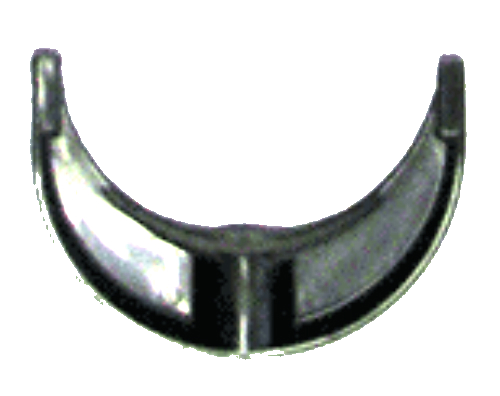
(Pronounced "stay-true".) A one-piece, U-shaped, molded-plastic cue head with integrated permanent flat runners. (For recreational cues)
Head, Titan
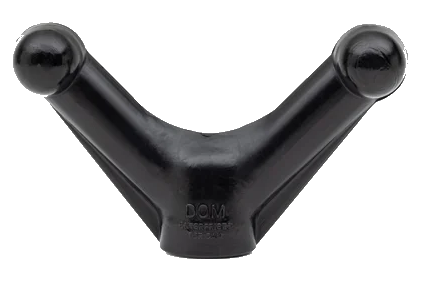
A one-piece, V-shaped, molded-plastic cue head with integrated permanent ball runners. (For recreational cues)
Head, Tuffy
A V-shaped steel cue head with replaceable ball runners, which bolts to a plug in the cue shaft. (For recreational cues)
Head, Wheelie
A 5 1/2W Swivel head with replaceable metal wheel runners in place of the swivel runners. The wheels have metal ball bearings and rubber O-ring tires. Designed for outdoor windy conditions to counteract the effect of the wind on the moving cue when shooting. Used mainly in Western USA., most frequently in Texas.
Headhunter
A player who often shoots to kitchen an opponent's Tampa or St. Pete guards, in preference to a clearing game. Similar to KITCHEN PLAYER.
Hesitation Shot
A shot where the shooter, while propelling the cue disc forward, noticeably slows or stops the cue and then accelerates it. Use of this shot in a tournament is usually subject to penalty.
Hidden
(of a scoring disc) Protected by a guard.
Hide
1. An area of the scoring diagram where a player can place a scoring disc that will be protected by an already placed guard. 2. Shoot or move a disc to a position where it is a scoring disc protected by a guard. Syn: SNEAK. 3. A scoring disc protected by a guard. 4. GUARD (def. 1). 5. BLOCK (defs. 1 & 2).
High
1. (of a scoring disc) In a position that is less than the width of a disc (six inches) behind the line or lines directly in front of it, leaving less space than needed for placement of a scoring disc in front of it, making it difficult to score the cue disc when shooting to clear the scoring disc. (Example: "Shoot a high 8 to stop the hammer.") Also, SHORT. 2. (of a guard) In front of its usual or ideal position. (Example: "I prefer a high St. Pete.")
Hit and Run
Clear both the target disc and the cue disc off the board in one shot.
A shot where the shooter, while propelling the cue disc forward, noticeably changes the direction of the cue and disc after the disc passes the baseline into play. Use of this shot in a tournament is usually subject to penalty.
Horse Collar
A frame-game format wherein partners stand and shoot from the same end, attempting to score as many discs as possible for the frame, their opponents then shoot from the opposite end to complete the frame. Syn: ADD 'EM UP, HOSS COLLAR. Originated as a table shuffleboard game in the late 1940s, named after the curved wooden end railings of a shuffleboard table which are a similar shape to a horse's collar.
Hoss Collar
HORSE COLLAR. 'Hoss' is a Southern dialectical pronunciation of 'horse'.
A colors (def. 1) tournament at the end of which the winners are each given a free ice cream treat and the losers have to pay for their ice cream treat (or every player gets a free ice cream treat but the winners get first pick).
Idiot Line
CENTERLINE. So named due to the often seen poor execution of the hammer shot to land touching the centerline instead of a scoring disc, making the shooter look foolish.
If You Can't See 'Em, Join 'Em
An expression that signifies a strategy to score a disc behind a guard as a response to your opponent having done the same, as an alternative to trying to clear or expose your opponent's well-hidden scoring disc.
The specific result a player decides the current half-round or sequence must accomplish after considering the score, who has the hammer, and who is strategically ahead. In Estes' Modular System, shot and play choices are judged by how well they advance this goal.
In
In a direction away from a side of the court towards the centerline.
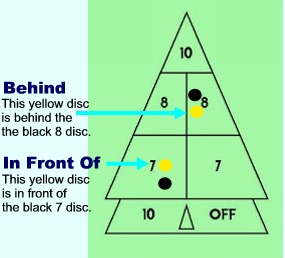
In Front Of
In a position that is closer to the shooters than a particular disc or location on the board.
In Play
Any disc that is a live disc. The cue disc is in play as soon as it fully crosses the 7/10-Off line at the shooting end during a shot.
In the Kitchen
(of a disc) Scoring in the 10-Off.
Inside
The side closest to the center of the board. (Example: “She shot to the inside of the 7, landing next to the centerline for a perfect hide.”)
International
A designation for the annual World Championship Tournament conducted by the International Shuffleboard Association.
ISA
International Shuffleboard Association: https://world-shuffleboard.org/
J
JNSA
Japan National Shuffleboard Association: https://www.jnsa1979.com/
CLEAR THE BOARD. This colloquial phrase implies that the fast-moving discs of clearing the board may pose a danger to "women and children" standing by the courts.
Bump a scoring disc onto or touching a line such that it is no longer scoring. Syn: SPOIL.
Kiss
(of the cue disc) Narrowly touch a side of a live disc intentionally in passing to reach a destination that can't be reached with a direct shot.
Kitchen
1. 10-OFF. 2. (of a disc) Cause to move into the 10-Off. 3. (of a shot) Intended to move a disc into the 10-Off. || The term Kitchen is borrowed from American billiards, for which it means the end quarter of the billiards table where the break shots are taken. The term is thought to derive from the 1800s in the U.S., when homes often were not large enough to house a billiards table in its own room. The solution was a billiards table with a cover to convert it to a dining room table. To accommodate the space needed for shooting billiards, the table was oriented in the dining room such that the player would stand partially or wholly through the doorway to the adjoining kitchen when shooting from the break-shot end, hence "in the kitchen". Pickleball has borrowed the term "kitchen" from shuffleboard, referring to the non-volley zone (NVZ), a 7-foot area on each side of the net where players are not allowed to volley the ball (hit it before it bounces).
Kitchen Bait
A disc purposefully shot by a player into an open position on the board, usually scoring, to tempt the opponent to try to kitchen it. The shooter hopes that the opponent's cue disc will miss the target and stop in the kitchen, glance off the target and stop in the kitchen, or stick on the board in the open where it can be kitchened by the player's next shot.
Kitchen Player
1. A player who often seeks to kitchen their opponent's discs, regardless of the score and risks, choosing this strategy over more conservative play, such as clearing the board or hiding a disc behind a guard. 2. A player who is proficient at kitchening opponents' discs.
Kitchen Speed
The speed of a cue disc that will result in the cue disc or a target disc to be kitchened.
Kitchen Speed Plus
The speed of a cue disc that will bump a target disc to stop either in the deep kitchen or beyond, used to prevent the target disc from stopping short, scoring in the 7, if the shot errs on the slow side.
Kitchen-Shy
(of a player) Shoot too slow to reach a target due to fear of shooting the cue disc too fast such that it or a target disc lands in the kitchen. (Example: "I was kitchen-shy and failed to score my hammer.")
L
L
Local: A designation on Florida tournament schedules, part of the tournament number, indicating a tournament is a District-only local event that is not an official FSA tournament. Such a tournament appears only on the schedule of the District where the tournament takes place, often restricted to a particular group of players such as one club or league. (Example: "L01" is the first District-only local event of the season.)
LADIES
A designation on tournament schedules indicating an event restricted to female players only.
Lag
1. A contest of two opposing players alternatingly shooting discs, up to four each, at the lagline to determine which player or partner team gets to choose their disc color before the start of a game, or to determine the game winner in the case of a tie. Until the final two discs, shot discs are for practice and are removed from the board after every two discs are shot, one for each player. The player whose final lag disc stops closest to the center of the lagline wins the lag, except the last player to shoot automatically loses if their last disc touches the other player's last disc. 2. Shoot discs for the lag.
Lag Winner
The player or team that has earned the right of color choice by winning the lag.
Lagline
The deadline closest to the other end of the court from the shooters. || In some locales, this term is used to refer to the further deadline both for all game play and when lagging; and in other locales only when lagging.
The accumulated Masters Points earned by a player over the course of their lifetime.
Line
The path the cue disc needs to follow to reach its target.
Line Game
A fun game format wherein players shoot to land on a line of the scoring triangle, each liner scoring five points.
Line Number
The number of the horizontal line on the tournament bracket diagram upon which a player's name first appears for match assignments. The lines on the diagram are numbered sequentially from one, starting at the top. Usually, in tournaments that use brackets, the player or partner team with the lower line number plays Yellow first in a match. Line numbers are usually assigned by random draw before the first match of a tournament, one line number for each player in singles or for each partner team in doubles.
Liner
A live disc that is not scoring because it touches one or more of the lines of the scoring diagram. Syn: DEAD DISC.
Live by the Kitchen, Die by the Kitchen
A tongue-in-cheek colloquial expression that makes the point that playing kitchen or attempting a kitchen shot is a danger to the player who attempts it, mainly used when the attempt has had a poor result. An alteration of the biblically-sourced proverb "live by the sword, die by the sword."
Live Disc
Any disc on the board during game play that is either in motion on the board or has stopped on the board touching or behind the further deadline from the shooting end, and hasn't touched an alley or person, or gone beyond the baseline of the receiving end. Sometimes a live disc is declared a dead disc as part of a penalty for a rules violation. At the completion of an end, after the scores are recorded, all live discs become dead discs and are moved to the starting area to continue play.
Beads that have been sprinkled onto the surface of the board before play and are liable to movement causing changes to the characteristics of the board as play progresses.
A designation for a tournament that is restricted to only players who have qualified by their tournament record, such as only the top points-earning players of a season. In Florida, the top eight Pro men and the top eight Pro women at the end of each season compete in a state Men/Ladies Masters tournament in round-robin format for places first through eighth for the year for men and for women. The Florida Masters was first played in 1960 at the St. Petersburg Shuffleboard Club. Some Districts in Florida also hold an end-of-season Masters tournament for the top players within their District, using a separate District Masters point system.
Masters Points
In some states, Expert or Pro players earn Masters Points within their state by placing in state association tournaments that award such points. The points leaders for each playing season may receive recognition and/or qualify for a special event. Masters Points also accumulate over a lifetime within the state, conferring milestone recognitions such as qualification for induction into the state Hall of Fame (e.g., 200 points in Florida; 350 points in Ohio; 300 points in Texas). Syn: HOF POINTS (Arizona), MASTER POINTS (Ohio), PRO POINTS (Florida), R.O.C. POINTS (Florida), STATE POINTS (Illinois), TSSA POINTS (Texas).
Masters Points, District
Districts in Florida award points at their District-only events, accumulating for a season as well as over a lifetime, for awards, recognition and/or end-of-season District Masters tournament, using their own District Masters point system.
Match
1. (in tournament events) A complete set of one or more competitive games played by the same opponents to determine who advances, in which bracket each advances, and/or what rank one or each places in the tournament. 2. (in league competition) A complete set of one or more competitive games played by two of the league teams.
MEN
A designation on tournament schedules indicating an event restricted to male players only.
Mess
(of the board) Multiple live discs on the scoring diagram during play of an end, which can result in more scoring discs than usual. A board can be "clean" (from clearing) or a "mess".
Midnight Madness
A fun, competitive event wherein singles frame games of four frames are played in an elimination tournament format. If a player ends any frame with a score of 19 they are immediately declared the game winner. Otherwise, the player with the highest score at the end of the four frames wins the game. Originated in Ohio at the Lakeside Shuffleboard Club in 1996, now played at Lakeside as one of three games for their Moonlight Madness.
Mingle Doubles
Mingle Singles when played as draw doubles. The term "Mingle Singles" is used both for a singles and a draw doubles tournament. "Mingle Doubles" can be used instead for a draw doubles tournament to make clear that each game is being played as random-draw doubles teams rather than as individual singles players.
Mingle Singles
A singles or draw doubles tournament format wherein each match consists of just one frame game, with a random draw for a new court, end and color assignment (and thereby a new partner in the case of doubles) for every player each match. Every player plays every match of the tournament - there is no elimination. Tournament winners are individual players, even when the games are played as draw doubles, determined by the number of games won by each player and/or the accumulated total of their winning games scores (or sometimes the accumulated total of all their game scores, whether won or lost). Originally for this format the tournament started with draw doubles games, and then the top eight players completed the tournament as a singles bracket event; the term "Mingle" represented the change in partners each doubles game; the term "Singles" represented the prizes being awarded to individual singles players rather than doubles partner teams. Sometimes when played as practice or fun games instead of as a tournament, the loser of a game pays the winner at their end a token cash prize, such as a quarter. Syn: COLORS, MINGLES, SCRAMBLES, YELLOW-BLACK.
A designation for a doubles tournament that is restricted to mixed-gender teams only, one man with one woman.
Modular System
A method of determining which player or partner team is currently ahead at any moment in a points game, and the best strategy to follow for the current shot or frame, as formulated and taught by the player and author Wilbur L. Estes in his 452-page book Modular Shuffleboard.
Moonlight Madness
A fun competitive event played at Lakeside Shuffleboard Club that includes one game of Midnight Madness, one game of Line Game and one game of Add 'Em Up.
Mounted Disc
Each of two live discs that are sitting one on top of the other. This results on a rare occasion from a forceful shot.
Move-Up Points
A type of point awarded to Amateur players in some states for placing in tournaments that award such points. Move-Up Points are accumulated to qualify for advancement in player status. For example, in Florida, a District Amateur who accumulates five or more Move-Up Points within a three-season period is awarded State Amateur status.
N
N
National: A designation on tournament schedules, part of the tournament number, indicating a tournament is a National Open Tournament. Such a tournament is listed on the USA-NSA Championship Tournaments schedule and may also appear on the tournament schedule for the state and/or District where the tournament takes place. (Example: "N01" is the first National open event of the season.)
N/C
NO COURT.
NA
National Amateur: A designation on tournament schedules, part of the tournament number, indicating a tournament is a National Amateur Tournament. Such a tournament is listed on the USA-NSA Championship Tournaments schedule and may also appear on the tournament schedule for the state and/or District where the tournament takes place. (Example: "NA01" is the first National amateurs-only event of the season.)
Narrow
(of a disc or position on the board) More towards the center of the court than normally targeted. (Example: "His St. Pete was too narrow, allowing his opponent to use it as his own Tampa.")
Nat'l
National: A designation on tournament schedules indicating a tournament is a National.
National
A tournament conducted by the USA NSA in conjunction with a hosting state, awarding National Points, and may also award Masters Points or Move-Up Points.
Nella Seal
An industrial floor wax for periodic application to a concrete shuffleboard court to protect the paint and surface, and to improve the speed of moving discs during play. Packaged and sold by the Allen Shuffleboard Company. ('Nella' is Allen spelled backwards.)
National Junior: A designation on tournament schedules, part of the tournament number, indicating a tournament is a National Junior Tournament. Such a tournament is listed on the USA-NSA Championship Tournaments schedule and may also appear on the tournament schedule for the state and/or District where the tournament takes place. (Example: "NJ01" is the first National Junior event of the season.)
No 2 Pros
A designation for a doubles tournament that does not allow teams of two Pro players. A team must consist of one Pro player and one Amateur player, or of two Amateur players. Syn: WILD.
No court assignment is given at the start of the tournament for the first match of a player or team. NO COURTs occur when there are more first round (def. 4) matches than the number of available courts and the affected players or teams must wait for a court to become available and assigned for their first match.
No Good
(of a disc) On the board but not as a scoring disc. Syn: NO COUNT.
1. A singles game wherein the players shoot from the same end of the court for all frames. Often, there are two players at the head of the court competing in a non-walking singles game and two other players at the foot competing in a separate non-walking singles game, with both games scored on the same scoreboard but in separate columns or rows. If only one game is being played on the court, usually someone is assigned to the court to be the pusher. 2. A singles tournament format wherein players compete in matches of non-walking singles games. Syn: NWS.
NR
Non-Restricted: A designation on some Florida District tournament schedules for a tournament that allows any player in the District to participate regardless of player status, including District Amateurs, State Amateurs and Pros.
NSA
USA National Shuffleboard Association: https://www.national-shuffleboard-association.us
1. (of a live disc or location on the board) Not covered or only minimally covered and therefore able to be targeted by a direct shot of the cue disc. 2. A designation for a tournament that allows any player to participate regardless of age or player status (age is limited to 18 or above in Florida). 3. (in Texas) A designation for a tournament that allows doubles teams that consist of two players from two different clubs or mobile home parks.
Open Board
The board during play when most or all the scoring diagram is unobstructed and unoccupied by live discs.
Open Doubles
A designation for a doubles tournament that allows partner teams of any combination of player statuses, two Pros, two Amateurs, or one Pro with one Amateur.
Out
1. Shoots first in an end. "Yellow out" means that the player shooting yellow goes first; "black out" means that the player shooting black goes first. Yellow is usually out at the start of any game. 2. (of a disc) Displaced from a scoring position. (Example: "He bumped his kitchen disc out.") 3. Achieve the number of points necessary to win the game. (Example: "They had a big lead but failed to go out.") 4. In a direction away from the centerline towards a side of the court. (Example: "Unlike most of their courts, yellow on the number four court drifts out rather than in.")
Pro: A designation on Florida tournament schedules, part of the tournament number, indicating a tournament is a statewide open event, awarding Move-Up Points to Amateurs and Masters Points to Pros. Such a tournament appears both on the FSA Open Tournament Schedule and the tournament schedule of the District where the tournament takes place. (Example: "P01" is the first statewide open event of the season.)
Partner
One player of a team of two players. Usually, partners play the same color at opposite ends of the court.
All four of one's discs counting for score at the end of a single frame of a game, or all eight of one's discs at the end of a single frame of speed shuffle.
Percentage Shot
The less risky of a choice of shots as it has a higher chance of success (that is, succeeds a higher percentage of the time). Best strategy often dictates taking the percentage shot even if it potentially has lower blocking or scoring value than a riskier choice. However, if the player is in imminent danger of losing the game, they may need to opt for the higher risk shot over the percentage shot.
1. A disc lying on the 7/10-Off line that is liable to be bumped up into the 10-Off. Often, a portion of the pigeon is lying within the 7, allowing the disc that bumps it up to stick as a scoring disc in the 7. Syn: CRIPPLE, DUCK, SITTING DUCK. 2. DISC.
Pilot
1. GUARD (def. 1, often the lead shot of a frame). 2. TAMPA.
Pin Shuffle
A points-game format wherein one bowling pin is placed upright on each scoring diagram, centered at the intersection of the centerline and the 10/8 line, the front edge slightly into the scoring area of the 10. Any time a shot causes one of the bowling pins to fall over, immediately the shooter receives a deduction of ten points from their score, the shot cue disc is considered a dead disc and removed from the board, and the fallen bowling pin is placed upright in its original position or as close as possible. Once a player reaches 65 points (or some other amount of points set for the game) or higher at the end of a frame, their score is pegged at 65 for the start of each subsequent frame, except it can go lower in a later frame if they are kitchened or they knock down a bowling pin. To win, in a frame subsequent to a frame in which their score is pegged at 65, a player must have a scoring 10 and a total score of 75 or more. If both players have 65 points at the start of a frame and both have a scoring 10 at the end of the frame, the player with the higher score wins, or the game continues if neither player has a total score of 75 or more or the total scores are tied. Syn: 10-PIN, PINS, SHUFFLE BOWL.
Make shot choices that emphasize developing and taking opportunities to kitchen the opponent's discs in order to reduce their score or lead, as contrasted with a blocking game or a clearing game. This strategy employs kitchen bait, kitchen shots, up-and-down shots, and reversing kitchens, and is especially useful after falling behind in score to gain the lead or prevent the opponent from reaching the final score in a points game.
Play the Board
Shoot the cue disc to score without the cover of a guard, as opposed to clearing, hiding or placing a guard. Usually done either as kitchen bait or to counter the opponent's anticipated strategy of hiding, or done by novice players who are unfamiliar with good strategy basics. Syn: CAT AND MOUSE.
Play the Drift
Shoot one's discs in a manner that compensates for the changes in the direction of moving discs due to the drift of the court.
Estes' compact decision aid for the Modular System. It organizes play by four conditions: ahead or behind combined with having or not having the hammer, then directs the player to establish the Immediate Goal and choose the corresponding strategy.
Point
1. APEX. 2. The score that wins the game in a points game.
Pointer
A stick, one end painted yellow and the other black, used by a referee to indicate which color is out, to point at scoring discs, to lay on the court for a pause in play, and to make various signals to players.
Points Game
A game that finishes at the conclusion of any end wherein the total recorded score of either or both singles players or of either or both teams of doubles players is equal to or greater than a pre-determined number, and the game winner is then determined by the highest score. Play may continue if the total scores are tied, usually for the number of additional ends needed to give every player one additional hammer (i.e., two ends in singles; four ends in doubles).
Poly Court
A court constructed from interlocking plastic tiles that are assembled on a flat surface for play and can be stacked for transport or storage.
Poly Glide Court Dressing
A mix of styrene beads and cornmeal used to dress a diamond-finished court before play. The cornmeal aids in keeping the beads in place on the court. This dressing comes in various configurations for various court conditions (e.g., with added silicone for wind resistance). Used in the Western USA. Syn: WAX.
Possible Double
A board relationship in which one shot may move or score two discs. The opportunity can be strategically important, but Estes emphasizes that doubles remain difficult and that routine hammer attempts at them are not percentage play.
Pot Luck
A fun-game format, played as singles or doubles, wherein a match consists of just one frame game, with a random draw for a new court and color assignment (and thereby a new partner in the case of doubles) for every participant each match. Sometimes players make a small wager (such as a dime or quarter) with their opponents on the outcome of a match.
The annual official publication of the FSA containing the upcoming schedule of play, official rules, tournament results of the previous season, Masters Points list, list of Hall of Fame inductees, District information and schedules, and other information on the FSA and shuffleboard.
1. A player who has advanced their player status within their state (such as Florida) from an Amateur status to Pro after accumulating a sufficient number of Move-Up Points by placing in state shuffleboard association tournaments that award such points to Amateur players, or by achieving other prerequisites to advance their player status to Pro. The term Pro in shuffleboard is not related to earning a living or a wage from play, as it is used in other sports. 2. A designation for a tournament that is not restricted to Amateur players only or is restricted to Pro players only.
Pro Points
(in Florida) MASTERS POINTS.
Pts.
Points: An abbreviation used on tournament schedules. Example: "75 pts/16 Fr." means that the tournament games are played to 75 points or 16 frames, whichever comes first.
Play using the most simplistic strategy of a novice, where the first player shoots their first disc into scoring, the opponent attempts to knock it out and leave their disc on the board, the first player then does the same, and this repeats until all discs are shot for the frame, the players relying mostly on lucky shots rather than skill and strategy to earn the most points.
Pusher
The person assigned to a court to help two players who are playing a non-walking singles game. The pusher sits at the opposite end of the court from the players and returns the discs to the players at the end of each frame. The pusher may also perform some referee duties when no referee is assigned to the court, such as calling discs, calling scores and removing dead discs; and may act as scorekeeper if the players are shooting from the foot.
Put a Handle On
Endanger a hidden scoring disc by shooting the cue disc to, or bumping a live disc to, a position where the cue disc or bumped disc can be used by one's opponent to target the hidden scoring disc with a combination or carom shot.
R
R
Restricted: A designation on some Florida District tournament schedules for a tournament that restricts the players allowed to participate based on player status, allowing only State Amateurs and Pros, no District Amateurs.
1. (of a disc) Pass off the playing area and then ricochet off the court backstop back onto the playing area. 2. (in Illinois) In tournament play, rebound and touch a live disc on the same court or cause another dead disc to touch a live disc on the same court.
Receiving End
The end where cue discs are shot to for a frame.
Reconditioning a Disc
Shaping a used disc to bring it back into good condition for play. Over time, discs accumulate from play chips on the bottom edges and scratches on the bottom surface, which need to be filled and/or sanded to restore smooth and speedy movement.
Redress a Court
Add beads to portions of the court surface where needed. This may include sweeping the court and dressing it entirely.
Referee
A tournament official appointed by the Tournament Director to oversee the officials, players, courts, and play for a Division, section of players, section of courts, a particular court, or a particular end of a court.
Referee, Court
A referee assigned to a particular court or match of a tournament.
Referee, Divisional
A referee assigned to a Division or section of a tournament.
Referee, Head
The tournament official that assigns and oversees all court referees.
Reindeer Games
TURKEY SHOOT. At St. Petersburg Shuffleboard Club, 'Turkey Shoot' is used for a Thanksgiving holiday event and 'Reindeer Games' for a Christmas holiday event.
Reinforced Hide
A hide (def. 1) that has more than one guard covering it.
A shot where a shooter's disc strikes the opponent's scoring disc, removing the scoring disc and leaving the shooter's disc as a scoring disc in its stead. Syn: REPLACE A DISC.
Reverse a Kitchen
A combination shot that bumps an opponent's disc into the kitchen where it bumps one's own kitchened disc out of the kitchen and the opponent's bumped disc stops in the kitchen in its stead. Syn: TRANSFER.
Road Map
DRIFT CHART. The term is usually used humorously or derisively.
Roll
1. A largely lateral movement of a disc after striking a target disc that brings it to stop on the board in a favorable position, often intentionally. (Example: "The cue disc had a perfect roll into the shooter's Tampa position after striking the guard.") 2. Cause a disc to move mostly laterally after striking a target disc in order to stop in a favorable position on the board. (Example: "He shot to roll his disc to a scoring ten after clearing the guard.")
Roll of Champions
1. (in Florida) A seasonal list published by the FSA of the top 24 men and the top 24 women, ordered by the total number of Masters Points earned in that state for the season. 2. (in Ohio) A seasonal list published by the OSA of all players who have earned Master Points in the season, ordered by the total number of points earned.
Roll-Out Court
A court constructed from a vinyl sheet, that is rolled out on a flat surface for play and can be rolled up for transport or storage. Used mostly for indoor play.
Roll-Over
A shot where a disc moves in a roll to a hidden scoring position after striking a target disc. Syn: TUCK IN.
Round
1. (In singles) The portion of a game wherein two competing players complete two frames of play, each color out for one. 2. (in non-walking singles) FRAME (def. 2). 3. (in doubles) The portion of a game wherein the competing players at each end complete one end of play, for a total of two completed ends, both for the same color out (e.g., yellow out at the head, then yellow out at the foot). 4. The portion of a tournament or other competition wherein all participating players complete one match. 5. The portion of a competitive event wherein all participating players complete all the matches for a segment of the event. (Example: "Round 1 will be complete after all players in each group of eight play one match against each other player in their group.") || (defs. 1, 2 and 3): Usage of the terms Frame and Round varies based on local, regional or state rules and customs. Each term may mean either completing one end or two ends of play, whether singles or doubles, depending on where you are playing. Players must clarify the local meaning by consulting local players, officials, or written rules.
Round Robin
1. A singles game format, usually played by three or sometimes by more than four players, wherein the players rotate shooting positions counter-clockwise after each frame. For example, in a three-player game, after the first frame is completed, the player at head yellow moves to foot yellow, the player at head black moves to head yellow and the player at foot yellow (who did not shoot discs in the frame) moves to foot black. When played by more than four players, each frame any excess players over four sit out from play, but with one player rotated in to play (to Head Yellow) and one player rotated out of play (from Head Black), maintaining the same order of rotation throughout the game. In a three-player game, play in any frame only takes place at the end with two players, the third player sitting out the frame at the other end. Syn: CUTTHROAT 2. A tournament format wherein each player or team plays a match against every other player or team in the tournament, or against every other player or team in a divided group of the tournament participants.
Runners
The pair of attachments, one on each end of the two prongs of a cue, that serve to couch the cue disc and allow the cue to slide smoothly on the court surface when shooting, without any other part of the cue contacting the court or cue disc. Most runners are largely triangular, are flat on the side that contacts the court, and swivel on a central axis; and sometimes they are concave on the surface that contacts the disc. Syn: SLIDERS.
Runners, Ball
Round plastic runners.
Runners, Big Foot
Swivel runners with a concave surface on the inner side to maximize contact with the cue disc.
Runners, Swivel
Plastic runners with a triangular shape but truncated flat instead of pointed ends. Designed to swivel on a central axis when shooting a cue disc such that through the end of the shot the bottom edge of the runner retains full contact with the court and the inner side remains in contact with the disc.
Runners, Westerner
Cylindrical Teflon runners with a pointed tip, that attach to the prongs of a cue head, designed for minimal contact with the court to minimize displacement of the beads. Especially for use in Arizona, California and other locations with diamond-finished courts.
Rush the Game
When ahead in a game or near to winning a game, take an unnecessary risk in order to bring the game to a faster close by attempting to score one or more extra discs that aren't strictly necessary to win the game.
S
Sanchez
1, A shot that intentionally or unintentionally involves multiple struck live discs resulting in a hoped for or unexpected exceptional outcome for the shooter. || Named after Carl Sanchez, a player at the St. Petersburg Shuffleboard club in the 1960s and 1970s, who often chose the more complicated, fancier shot over the simpler higher-percentage shot. He was renowned for often succeeding at such shots, but overall was not a winning tournament player due to his preference for showmanship over best strategy. (Example: "His Sanchez gave him 25 points for the frame, to recover the lead.") 2. A shot that puts two of the opponent's discs in the kitchen as well as scoring one or more of the shooter's discs.
Sand
1. Fine clean sand that is sprinkled on a court to reduce the friction between the bottom of the discs and the court surface, now rarely used and not recommended for modern courts. 2. BEADS.
Score
1. Make a shot such that one or more discs of one’s own color becomes a scoring disc. 2. The current total points of each of the competing players or player teams in the game being played. 3. SCORING DISC.
Score One's Hammer
1. Score at least 7 more points than one's opponent for an end where one had the hammer shot. 2. Shoot the hammer disc such that it adds at least one scoring disc to one's total for the end.
Scoreboard
The display board at the head of a court used to record and accumulate player or partner-team scores at the completion of each frame of a game.
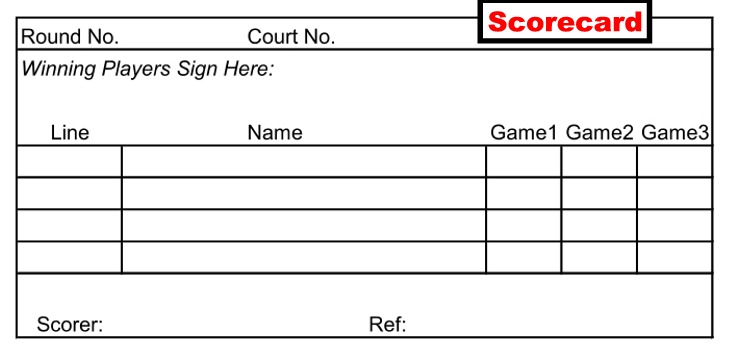
Scorecard
At tournaments, a printed card on which the scorekeeper or the players record their match results, to be turned in to the Tournament Director after completion of a match.
Scorekeeper
The person who tallies and records on the scoreboard of a court the scores of players or teams at the completion of each end of play. Syn: SCORER.
Scorekeeper, Head
The tournament official that assigns and oversees all scorekeepers.
Each of the areas within the scoring diagram where a live disc is a scoring disc, including the 7s, 8s, 10 and 10-Off.
Scoring Diagram
The set of painted lines at each end of the court, mostly triangular in overall shape, that define the areas where stopped live discs score points. Sometimes the term excludes the area forming the 10-Off. Syn: BOARD, HOUSE, SCORING TRIANGLE, SHUFFLEGRAM, TRIANGLE.
Scoring Disc
A live disc that has stopped inside the scoring diagram not touching any lines with the exception of the lines of the separation triangle in the 10-Off. Syn: COUNTER, NUMBER, SCORE.
Shaping a newly manufactured disc. New discs often have a somewhat concave or convex bottom surface, and often lack a beveled edge. The discs must be put through the shaping process to give them good performance characteristics.
See
Discern a portion of a hidden disc that is sufficiently exposed to be targeted by a direct shot of the cue disc.
Separation Triangle
The painted triangle in the center of the starting area that separates the starting area into two equal halves, one for each of the two colors of discs. Often it is painted as just two angled lines that outline a triangular shape. Syn: CARET, DIVIDER, DIVIDING TRIANGLE.
Setup
Placement by a player at the receiving end, in a set or requested pattern or location on the board, of one or more target discs or of an end of a cue for targeting by the shooter of practice shots before the start of a game. Placement of opponent’s discs as target discs for setup is not allowed in some locales.
Altering the shape of a disc by sanding to achieve smooth movement and speed. The goal of shaping is a flat and smooth bottom surface, often with a beveled bottom edge.
The end where cue discs are shot from for a frame.
Shooting, Path
A technique of shooting wherein the player determines the path forward that the cue disc must follow from the start of the push forward until the disc leaves contact with the cue head, for correct aim of the disc. The player focuses their gaze on the cue head throughout most or all of the shot to ensure that the cue disc follows the correct path.
Shooting, Sight
A technique of shooting wherein the player sights the aiming spot at the opposite end of the court and focuses their gaze on this spot through most or all of the shot for correct aim of the disc.
Shooting, Spot
A technique of shooting wherein the player determines a spot on the nearest scoring diagram that the cue disc must cross over for correct aim of the disc. The player focuses their gaze on the spot throughout most or all of the shot to ensure that the cue disc passes over this spot.
A 75-point game format wherein both players or partner teams starts with a score of 43 or 45. Used mainly in friendly games to practice proper end-game strategy for tournaments.
Shot
The technique and motions of propelling a cue disc with a cue towards the opposite end of the court by a player. The components of a shot are Grip, Stance, Aim, Steps, Swing and Follow-Through.
Shots, Practice
A set of shots by each player on the court taken before the start of a game to learn about the characteristics of the court and the discs, and to practice shooting before game play. Before the first two games of a match in Florida official tournaments, there are usually two speed shots by each player, followed by four setup shots for each player, and then four more setup shots for each player. Officially, the term Practice Shots refers to the setup shots only, exclusive of the speed shots, but sometimes the term is used to mean both the speed shots and practice shots together (as does the term Practice Round). In some other states, there are for each player just four practice shots that are not setup shots.
Shots, Setup
Practice shots taken before game play exclusive of any speed shots, with setups allowed.
Shots, Speed
Shots before the start of a game to learn about the speed of the court and discs. There are usually two speed shots for each player prior to the practice shots before a game begins. Players are not allowed to use setups for speed shots.
The left or right half of the court identified by the color played from the starting area on that half. A court has two sides, yellow and black. Viewed from the head of the court, yellow is on the right side and black on the left side.
Sidelines
1. The diagonal lines of the scoring diagram that define the sides of the 7 and 8 scoring areas. Syn: ANGLE LINES, OUTSIDE LINES. 2. The diagonal lines along the sides of the 10-Off.
Silent Captain
The scoreboard as a guidepost to decide during a game one's best choice of shot or game strategy going forward, taking into account the current recorded scores on the scoreboard, the number of points or frames remaining in the game, which color has the current hammer, the color that has the next hammer(s), and other strategic factors.
Singles
1. A game wherein one player competes against one other player. 2. A tournament format wherein players enter the tournament individually rather than as partner teams and each match is played as one player competing against one other player. Syn: SGLS.
Singles Mingle
1. A tournament format wherein players start out playing a series of singles games (hence "Singles") in a mingle singles format, with two separate divisions - one for men and one for women. When this portion of the tournament is complete, the top eight players from each division are combined for a draw doubles bracket competition, partnered by random draw in mixed partner teams of one man and one woman (hence "Mingle"), to play for the final four winning places. 2. A misnomer for "Mingle Singles".
Sit On It
1. When clearing a scoring disc, intentionally cause the cue disc to stick as a scoring disc in a high position such that it is difficult for the opponent to score when clearing it. 2. SNUGGLE.
1. (of a court) Requires more propelling force than usual to slide discs from one end to the other due to the condition of the court. 2. (of a disc) takes more force than usual to be propelled down the court due to the condition of the disc.
Slow Play
Take excessive time to make shots. Repeated slow play in tournament may be subject to penalty, in some locales defined as more than 45 seconds to make a shot.
Sneak
1. A shot to directly place the cue disk in a scoring position that is protected by an existing guard when shot between two guards or behind a guard that is in a position that usually acts as a guard for the opponent. 2. Shoot such a shot. 3. HIDE (def. 2).
SNGLS
SINGLES (def. 2). An abbreviation used on tournament schedules.
Snuggle
Place a disc, usually as a scoring disc, close to or touching, and in front of, a live disc. Syn: CUDDLE, JOIN, NESTLE, SIT ON IT.
Soft
(of a shot) Relatively slow.
Soup
10-OFF || Derived from the circular motion given as a hand signal when a disc lands in the 10-Off, representing the circle placed around a negative score on the scoreboard. This motion is visually equivalent to the stirring of a pot of soup, which is also tied to the literal sense of the term "kitchen", also used for the 10-Off.
A competition between a number of players, each shooting on a separate court, wherein all players shoot single discs synchronously on command of a referee until a complete set of discs are shot for the frame, each trying to accumulate the most points for the frame. Usually, a disc in the kitchen scores plus ten points instead of minus ten, and usually the number of frames played is equal to the number of players competing, often with players rotating to a different court for each frame. This format is primarily used to break ties between players at the end of a round in a round-robin competition.
Spinner
An electro-mechanical machine that spins discs to facilitate cleaning and waxing of the bottoms. Usually a wooden box enclosing one or two electric spin motors, often repurposed from a floor waxing machine, with attached spinning platforms on which discs are laid bottom up. To apply a coat of wax, with the motor spinning the disc a solid wax stick is drawn across the bottom, or a paste wax is spread on it with a soft cloth.
Split
A setup for a practice shot where the target disc is placed straddling the centerline between the 8s at the receiving end, to allow the shooter to attempt to double the target disc.
A guard that is about halfway between the apex of the scoring diagram and an edge of the court. A St. Pete is usually an effective guard for a player when positioned on the same side of the court as the player's opponent. Syn: CROSS GUARD, CROSS PILOT.
The position of a player's body in preparation to make a shot.
Stance: Stand with your feet a comfortable distance apart, feet evenly square to your shoulders, weight distributed evenly between your feet. Set the head of your cue against the disc, then move your body to place your arm hanging loosely by your side, and your hand next to your hip.
Standing Area
The area of the court between the rear edge and the baseline, where players stand and step when shooting discs. Syn: APPROACH, APRON, SHOOTING AREA.
Starting Area
The 10-Off section of the scoring diagram at the end from which the players are shooting. Before the start of an end, all the discs are placed within the starting area before any disc is shot. In game formats wherein competing players shoot from the same end, one disc color assigned to each, the separation triangle separates the two colors of discs, yellow placed on the right and black on the left when shooting from the head of the court, or yellow on the left and black on the right when shooting from the foot. Syn: LAUNCHING AREA, STAGING AREA, SHOOTING AREA, STARTING PANEL. || This term, and its synonyms, may be used in either the singular or plural: Starting Area referring to both halves as one; or Starting Area referring to just one half side (e.g., "The yellow starting area.").
Starting Line
The 7/10-Off line at the shooting end. Once a cue disc is fully across this line, it is in play.
One of the four lateral positions of a disc within the starting area before being shot. The positions are named one through four on each side of the starting area, beginning with the position closest to the center, each position accommodating one disc. (Example: "He prefers to shoot most of the time from the one, and almost never from the two-and-a-half. But his opponent on black shoots most of the time from the two.")
State Amateur
(in Florida) A player advances their player status from District Amateur to State Amateur (effective the following October 1st) after accumulating a sufficient number of Move-Up Points (5 points within a three-season period) by placing in several FSA tournaments that award such points to Amateur players. Once a State Amateur, the player must accumulate additional Move-Up Points (5 points within a new three-season period) to advance their player status to Pro (effective the following October 1st).
State Points
(in Illinois) MASTERS POINTS.
State Sponsored Tournament
(in Florida) Any of the six tournaments conducted annually by the FSA: Singles Championship; Doubles Championship; Amateur Singles Championship; Amateur Doubles Championship; Masters; and Tournament of Champions. The tournaments are rotated annually between the FSA Districts, on a published rotation schedule, each one hosted by one of the member clubs in the assigned District.
Statewide Tournament
(in Florida) A tournament that is open to all players that have a membership to any member club of the FSA. Statewide tournaments are hosted by member clubs, as approved by the club's District and the FSA, and published on the FSA Open Tournament Schedule or the FSA Amateur Tournament Schedule, as well as on the District's schedule.
Steal the Hammer
1. Prevent your opponent from scoring their hammer (see SCORE ONE'S HAMMER def. 2). Syn: STOP THE HAMMER. 2. Score the same or more points than one's opponent for an end where the opponent had the hammer shot.
Steam
A humorous descriptive to point out that a disc has landed in the kitchen. (Examples: "Your disc is steaming now!"; "The steam is rising on that one!") || A play on words of the colloquial term 'soup' for the 10-Off.
Steps
One or more steps forward taken by a player during a shot to impart motion to the cue disc.
Steps: Take a small step with the foot next to the cue. Don’t move the cue, hand, or stick while making the small step. Don’t let the cue head pull back from the disc. End the small step with your full weight on the forward foot, your hand now somewhat back of your hip. Next make a larger step with your other foot, ending with knee somewhat bent and full weight on that foot. (Alternatively, you can make just one large step with the foot opposite the cue but in that case, start with your hand somewhat back of your hip instead of next to it, elbow unbent.)
Stick
1. (of a disc) Stop on the board at or near the point of contact when clearing a target disc, usually unintentionally. 2. (of a disc) Stop somewhere exposed on the board. 3. CUE. 4. TANG (def. 1).
1. A too-narrow St. Pete or too-wide Tampa intentionally placed out of the correct position to tempt the opponent to use it as their own guard, luring the opponent into shooting a disc on the board where it might be kitchened rather than shooting a clearing shot, a guard or a dead disc. 2. Any disc placement that lures the opponent to attempt to hide a disc when their best current strategy includes staying off the board to avoid the possibility of being kitchened.
Suicide Alley
The path for shooting a disc that goes from the position in the starting area closest to the nearest edge of the court down to the other end on the same side, keeping towards that edge of the court. So named because the cue disc stops in the 10-Off instead of a scoring area when hiding behind a guard more often than on any other path down the court. Syn: ALLEY, PRIMROSE PATH.
Sweep a Court
Use a broom to sweep off all dressing from a court, as well as any dust, dirt and debris.
Swing
A continuous movement by a shooter of the hand and arm that moves the cue, to propel a cue disc forward for a shot. Syn: STROKE.
Swing: As your take the second larger step, or at the end of it, make a pendulum swing with the arm and hand holding the cue to push the disc. Keep your elbow unbent and push straight forward in the direction you have your body and cue aimed. Do not move your hand, wrist, arm, or stick to one side or the other to aim the disc – you have done all your aiming before the steps. The speed is not determined by the muscle strength you put into the shot, rather by the speed of the swing. For a faster shot, to send the disc faster or further, swing faster; for a slower shot, to send the disc slower or shorter, make a slower swing.
Swing, Pendulum
A swing that starts with the hand holding the cue extended back past the hip of the shooter and continues forward with an unbent arm out to the full extension forward, the arm and hand simulating the motion of a pendulum.
T
Take Out
1. Remove an opponent's disc from its favorable position or one's own disc from its unfavorable position (such as a kitchened disc) by striking it with the cue disc or with another disc moved by the shot. 2. Such a shot successfully executed.
A guard that is to one side of and near to the apex of the scoring diagram. A Tampa is usually an effective guard for a player when positioned on the same side of the apex as the player. Syn: PILOT.
Tang
1. The shaft portion of the cue, from the tip to, but not including, the head. Syn: STICK. 2. CUE.
Target
A disc on the board that is the intended point of contact of the cue disc or a location on the board that is the intended destination of the cue disc.
Target Disc
A disc on the board that the shooter targets to be contacted and moved by the cue disc or by another disc that is moved by the shot.
Target of Opportunity
An unexpected shot opportunity created by a mistake, poor execution, or changing board position that offers an attractive alternative to the player's planned Immediate Goal. Estes warns that accepting it without recalculating the need can undermine disciplined percentage play.
A double-elimination singles tournament format wherein games are 16 frames, a usual format for tournaments played in Texas (20-frame format is also often played in Texas). The term originated at the Hendersonville Shuffleboard Club in North Carolina, where some players from Texas introduced the format as something fun and different from the usual tournaments played in Hendersonville.
Thread the Needle
Shoot the cue disc accurately between two or more discs on the board to a target.
Tip
1. APEX. 2. The end of the cue that is held with the hand when shooting.
Tipper
A live disc that has stopped with about half of the disc extending beyond the edge of the court, balancing over but not touching the gutter, unsteady and ready to tip into the gutter.
The area of the board between the deadline and the apex.
Tourist Disc
A cue disc that completely misses a target disc in an attempt to clear, and continues well beyond, usually through the kitchen and off the playing area.
Tournament Director
The official in charge of all arrangements, conduct, officials and rulings for a tournament. Syn: TD, TM, TOURNAMENT MANAGER.
An annual tournament restricted to players that have qualified for entry through previous tournament accomplishments, such as placing first in a state-wide tournament, or other qualifications. Syn: TOC.
Trailer Park Shuffleboard
A derogatory label for a player's choice of shots or style of play that is more fun, fancy, novice-level, or sensational than the best strategic shot or style, as is more commonly seen employed by mobile-home-park club players than official-tournament players. (Example: "His attempt to kitchen his opponent's scoring disc rather than just knock it off the board was Trailer Park Shuffleboard.")
A disc shot onto the board meant to entice the opposing player into making a strategy mistake, such as leaving a different live disc on the board, taking a shot that results in a score disadvantage, or leaving an opportunity for the next shot to give a strategic or score advantage.
A singles tournament format wherein every player shoots on a separate court a full set of discs for each frame, to score as many points as possible. Usually, a disc in the kitchen scores plus ten points instead of minus ten. Reportedly so named as originally a turkey was awarded as a prize to the winner. Syn: REINDEER GAMES.
Turn Around
The halfway point in a frame game wherein each player plays the first half of the game on one color and then switches to the other color for the second half. Such a game is often designated as "X/X Format", where "X" represents the number of frames or rounds are played on each color (e.g., "4/4 Format"; "6/6 Format"; "8/8 Format").
Two Hide Offense
A developing offensive pattern in which more than one hide is available, forcing the opponent to spend discs dealing with multiple protected scoring threats. Estes treats it as a situation that develops from play rather than something that can always be planned in advance.
U
Umpire, Court
A referee assigned to the foot of a particular court.
A shot where the cue disc bumps up the opponent's scoring disc from the 10 to the 10-Off and the cue disc sticks in the 10 as a scoring disc. The result is "10 Up" for the shooter and "20 Down" for the opponent (whose disc went from plus-10 to minus-10, for a 20-point swing down). Syn: 10-MINUS-10 (a scoring 10 for the shooter and a scoring 10-Off for the opponent).
Uphill
Against the direction of the drift.
USA NSA
USA National Shuffleboard Association: https://www.national-shuffleboard-association.us
W
W
WALKING SINGLES (def. 2). An abbreviation used on tournament schedules.
Walking Singles
1. A singles game wherein the players shoot all the discs from one end of the court to complete the end, then walk to the other end of the court to shoot all the discs from there to complete the next end. The players continue in this manner, walking to the other end of the court after completion of each end. 2. A singles tournament format wherein players compete in matches of walking singles games. Syn: W.
Waste One's Shot
Shoot to place the cue disc into a position that is outside the scoring diagram and doesn't afford any positional advantage (e.g., doesn't serve as a guard or block), or to become a dead disc (into an alley, beyond the kitchen or short of the deadline), without targeting any other disc on the board. This shot is made, usually when one is ahead in score, to avoid giving one's opponent an opportunity to kitchen the shot disc, hide behind it or use it for some other advantage.
Wax
1. Paste or hard wax that is applied to the bottom surface of discs to reduce the friction between the bottoms of moving discs and the court surface. 2. Apply paste or hard wax to the bottom surfaces of discs. 3. BEADS (in Western USA). 4. POLY GLIDE COURT DRESSING. 5. Liquid floor wax applied to a court surface for sealing, protection and reduction of friction.
Weight
1. The relative strength of the propelling force of a shot. (Example: "It was the right weight to reach the deep 7.") 2. DISC.
More towards the closest edge of the court than normally targeted. (Example: "He shot a wide St. Pete to prevent his opponent from shooting down suicide alley for a score.")
1. The lighter of the two colors of a set of discs. 2. The player who shoots this color discs. 3. The side of the court where this color discs are placed in the starting area.
Yellow Court
A court that favors the player or team shooting the yellow discs due to the drift of the court, aiding the yellow shooter to place a scoring disc hidden behind a Tampa or St Pete. Usually a yellow court has more drift from the yellow side towards the black side, but if that drift is too strong, such a court might favor the black instead.
This online Dictionary is built from CourtShuffleboard.com’s prepared court-shuffleboard terminology dataset. It preserves source-specific and regional meanings where they matter and can be expanded carefully as additional terms are reviewed.
For current playing rules, use the governing rules for the organization, event, or location where you are playing.