
OBSERVATION • EXPERIENCE
Watch and Learn
Watching expert players can teach a great deal—but only if you understand the context of the play you are watching.
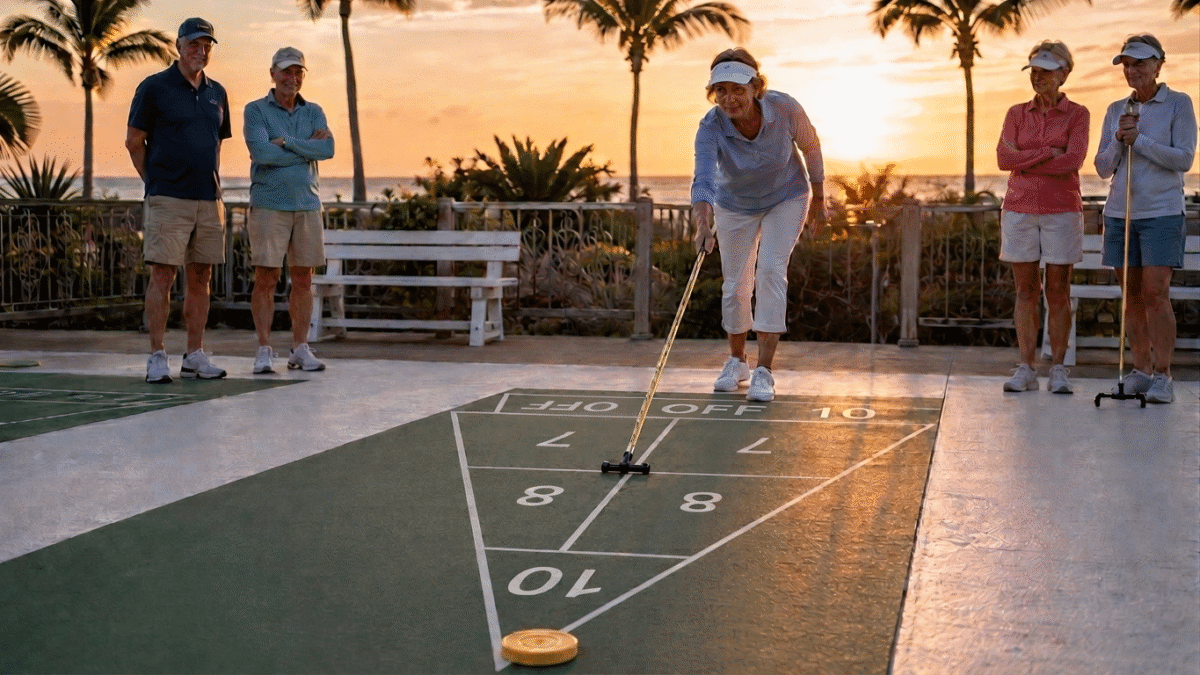
A great way to learn more about optimum shuffleboard play is to watch expert players. Even better is to avail yourself of opportunities to play with or against them. However, there are pitfalls to be aware of.
Home Court Advantage
When you see “expert” play, it’s not always as it seems. The expert player may simply be playing their home court or another venue which imparts an advantage to their playing style, often to the point of making less-than-optimum strategy seem to be superior strategy. While the strategy works for the local venue, it doesn’t necessarily work out very well elsewhere.
A perfect example of this is the kitchen play at Pinellas Park Senior Center in Florida. It’s quite common for these players to play kitchen right off the bat, shooting unhidden discs on the board so they’ll be able to kitchen you if you stick. Or shooting to put your Tampa guards in the kitchen rather than just clearing the board. A few of these local experts are still winning players when they play at other clubs, but very few. There is a very good reason for this: most of the courts at Pinellas Park grab and stick any disc that is close to kitchen speed when it passes into the kitchen area! It’s just a quirk of those courts. I think either the permanent beads of the courts were shorted when the beads were embedded, or they have been somewhat trampled down over the years.
Those few local expert players who are still great players at other venues either play a better strategy elsewhere or are simply truly great players, combining their home-court skills with other winning skills and strategies. When you investigate a little closer, you find that these players are well-experienced, having traveled and played at many venues for years, not just on their home courts.
Casual Play
There are lots of places to watch or even play with the true experts. Just be aware of what type of play you are watching. The expert players don’t always play their best, depending on what they are trying to accomplish. More casual competition, such as summertime local tournaments, might only be used by these players to test or practice varying shots or strategies, rather than the stricter play of serious competition. Or they ease up on their play as it’s more of a pastime to them during the summer than their usual.
If you were to visit and play the summer Mingle Singles series in Betmar, Zephyrhills and Lakeland, Florida, for instance, you will find some top Hall of Fame players. Although they still dominate the field, they aren’t necessarily playing their top game, on purpose. You can still learn plenty from watching them, but don’t take everything they do as optimum game play.
Boring Vs. Exciting Play
Even at the most competitive tournaments, the top players aren’t necessarily playing the optimum strategy, by choice. Theoretically, if you pitted two experts and both were playing optimum strategy, probably both would just be playing clear-clear-clear-score your hammer, every frame until mistakes are made or the game is close to the finish. This is boring play!
I asked Tom Feeley, a top player out of Clearwater, Florida, and a Florida Masters champion, why so many of the expert players at the Masters tournament do a lot of snuggling, playing the board, kitchen play, etc., rather than just the clear-and-score strategy. He explained that many players will play the more boring clear-and-score strategy while they are still earning the points needed to get into the Florida Hall of Fame. Once they make it, they often change their game play from the “boring” clear-and-score strategy to fancier, more exciting play.
Sympathic Play
As you expand your reach and find opportunities to play against the expert players, sometimes they will let up on you during a game. It’s a form of sympathetic play, so they don’t simply crush your desire to compete. You will learn a lot from competing against them, but don’t assume that every move they make is always the best choice, especially when they have a significant lead in scores. Many will also be willing to help you learn, so don’t be afraid to ask them what they would have done in your place or why they made the shot they did. If you are lucky, your opponent will never let up on you and you’ll be able to observe superior play throughout.
Game Variants
Varying game formats can have different optimum strategies. Points games are more about the rush to the winning point score, while frame games are more about preserving your lead to the final frame. Mingles, although usually limited in frames, reward higher final scores when winning scores are carried over to a tournament total to determine winners’ rankings. There are many more examples. Be aware that optimum strategy will vary with game format when you are watching to learn.
The Books Are Right
For the most part, the published books on shuffleboard are correct about the best strategy. The more advanced the book, the more correct it is. If what you see on the courts differs from what you read, usually what you read is better. But you have to take into account that the books are more general than the specific circumstances of the game you are watching. The book may be geared towards a specific skill level, a particular playing surface or a particular competitive format. Or the players you are watching may have history with each other, knowing their opponents’ strengths and weaknesses, varying their own play accordingly.
Learn, Learn, Learn
Don’t ever think you have figured shuffleboard all out. There is always more to learn. While I have used the term “optimum strategy”, take it with a grain of salt. There isn’t necessarily only one correct answer for every situation. Learn everything you can from watching the experts, to integrate into your game play. But never think you have the final answer and always be open to learn more.