
TOURNAMENT STORY • DECISION-MAKING
Oops!
A high-pressure tournament mistake, the thought process behind it, and the lesson that followed.
It’s been some time since I’ve written a shuffleboard article. It’s not for lack of ideas, stories, strategies or teachings that I wish to impart to other shufflers. All of my previous articles addressed topics and issues of concern mainly for novice and amateur players. As the top-of-the-rung Amateur player in my district for three seasons running before I achieved my Pro status, I felt that I had the chops to speak to that audience.
I am now halfway through my second season playing as a Pro. The same sort of achievement on the Pro side still eludes me. I feel the first milestone on that path is to take a first place finish in a State Pro tournament (which I did a couple seasons ago as an Amateur with a Pro partner, but not yet as a Pro). I have come close a few times, and I’m currently sitting at #16 on the Pro points leaderboard for the season, but to my mind that simply isn’t enough yet to consider myself a player with the knowledge, experience and performance record that justifies writing articles about Pro tournament shuffleboard.
But here I am, doing just that. Yet I’m not writing about great things I did, shots or strategy. Surprising even myself – my first article addressed to the Pro side is about a terrible, idiotic mistake I made while playing in the last Pro tournament of this calendar year.
My partner for the tournament is a solid player, in his fifth year as a Pro. We won our first two matches against a couple of strong teams from out of our district, playing with a home-court advantage in Clearwater. Our third match was against one of the top-two teams in the state, the two players currently holding spots two and four in the Pro points leaderboard for the season. The match was the tournament semi-finals, to determine which team would go on to play for first, the losing team to play for third.
We lost our first game, won the second, and my partner won the lag to give us color choice for the third, which was important as Yellow, the color we chose, definitely had a drift advantage on the court. Both teams had won a game on Yellow. After an hour or so of game play for the third game, the score stood at 59 to 56, Yellow out at the head, where my partner was playing. We just needed two hammer 8s to win the match. Even if our opponents also each scored a disc on our hammers, we would still win without much risk if we scored as well. They couldn’t stop us simply by scoring high 8s or 7s with their last discs on our hammers.
At the head, Black put up a St Pete with the first disc. My partner shot and scored an 8 on the same side. Huh?! All he should be doing is clear and score the hammer. There were several shot choices my partner made over the course of the tournament that differed from what I would have chosen. More than once, the way a frame developed put us behind and I had to find ways to steal a hammer or score an extra disc to get us back in the lead. I took it all in stride, just doing what I needed to do to win. In fact, that is the exact reason I played the foot every match, regardless of how the opponents seated themselves. I wanted to be in a position to play the board and make the fancy-play shots when it was needed to recover from partner errors. It was working.
Getting back to the frame at hand, my partner continued to play a board game rather than the simpler clear-and-score approach I would have preferred. In the end, he did score an 8 for the frame, but Black scored two discs, to put the score at 67 to 71. Still, I just had to score an 8 to get to 75 on my hammer next frame for the win, although I couldn’t let my opponent get a matching score to outpoint me.
My opponent started the frame by shooting a Tampa that landed about seven inches wide of the point. The drift of the court favored me to be able to place a score mostly hidden behind it. I had to consider that my opponent could also use it as a Tampa to hide his own scoring disc. Normally I would just clear, clear, clear until my hammer, but I knew my opponent to be a crack shot, expecting him to place a high 7 on his last disc to stop my winning 8. So I settled on scoring behind his Tampa as my best choice, scoring a good 8.
My opponent looked, checked his chart, examined the board from the left and from the right, thought it over, and finally settled on a shot from the outside to score behind the Tampa, and, with his drift in, he also pushed my scoring 8 onto the 7/8 line, with about an inch still sitting in the 8. I could go for a double, but that would leave it vulnerable to a clearing shot that could leave a scoring disc for my opponent, or one in the kitchen for me. Instead, I used the drift to shoot behind the Tampa, tapping his scoring 8 out of the box and leaving my disc scoring, albeit half exposed. What an exciting frame!
Next, my opponent shot to clear both my discs, but only got my scoring 8 out, leaving my liner in place. He had one disc remaining and I had two. I could go for the double, but the liner was so close to the middle line and not much sticking in the 8 that it was risky. Even if I made the double, my good 7 would by necessity be just a little over the 7/8 line, leaving my opponent with shot to push my good 8 onto the line, knocking my good 7 off of scoring (maybe into the kitchen) and sticking for a good 8 Black snuggling my new 7/8 liner. Alternatively, I could shoot for hiding an 8 again, but that would leave other options for my opponent – a combo shot to put my liner in the kitchen, or maybe a direct kitchen of the 8 or of the 7/8 liner, or clear and score behind the Tampa like he did on his previous shot.
Instead, I chose to snuggle in front of the 7/8 liner. I wasn’t certain it was the best choice, still rolling around the possibilities in my mind while shooting rather than being settled on the choice. Any good shooter knows this is likely to lead to a shooting error. Oops! Yeah, oops, I missed my shot. But that isn’t the “oops” for which I titled this article. And it wasn’t the terrible, idiotic mistake that I confess. This shot arrived almost where it was meant to land, but stayed a little left to remain an 8/8 liner mostly in front of my 7/8 liner, with just a tiny bit of the edge sticking over into the Yellow-side 8. Without hesitation, my opponent shot his last disc for a high 7 on the Yellow side, stopping just 4 ½ inches beyond the line.
Now came my real “oops”. If not for writing this article, no one would be the wiser. Everyone, including my partner, the players of the opposing team and those watching the match thought I made a decent hammer shot. The truth is, I didn’t. And the sad, embarrassing reason that I didn’t is that I didn’t properly figure out the math. Anyone who knows me knows that I’m always, every shot in every game, considering the math of who is ahead, who is behind, and what I have to do for the current shot and frame to achieve a win. I’ve written articles on it. I’ve studied it extensively in the books on shuffleboard. I’ve coached it over and over. I’ve even got a sponsor court plaque and matching hat that emphasizes it. So what the heck happened?
The Real “Oops”
Looking at the board for my final shot (see illustration), I knew I couldn’t win by a direct shot to clear the Black 7. If I cleared and scored, the game would go on, score 74 to 71, two hammers for Black. Even if I somehow managed to kitchen the 7 and score, the game would go on at 74 to 61, allowing Black to win with the next two hammers. I had to get either two scoring discs, or somehow clear the 7 and score an 8. I looked over the board and had a stray thought – how had we gotten into this mess when the frame before we had only to score our two hammers to win the match? I looked back at the board, my thoughts muddled and clouded. I looked and tried to figure out how I might score all three of my discs – the two liners as well as my hammer – a possible, very difficult shot. Why was I considering that shot? I like to consider all possible shots. In this instance, I considered that one, then considered how I could ricochet off my 8/8 liner, score it and carom off to clear the Black 7. I chose the latter as the likely more successful of the two shots and shot for it.
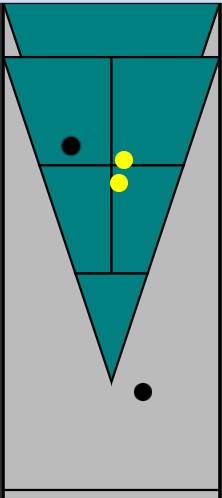
OOPS!!! I can hear you shouting, why didn’t you just shoot any double for the win? I could have bumped the 8/8 liner to score two 8s or an 8 and a 7 in multiple ways. Any double would have given me the win. As it was, I shot to score the 8/8 liner but at the speed necessary to carom the cue disc into the 7 to clear it. Instead, my 8/8 liner bumped the 7/8 liner beyond the kitchen, stuck as a good 8, and left my cue disc lying just a half inch onto the centerline in the Yellow-side 8. I scored just one disc and lost the match, 75 to 78. Everyone who witnessed it thought I tried to double. I should have. I didn’t. As a result, we played our finals match for third place instead of for first place.
So what really went wrong? Why did I take the wrong shot at that critical moment? Making a careful examination of my thought process in retrospect, I have to admit, shame-facedly, that I actually thought that I would be outpointed if I just scored a double. It was an error in my thoughts from considering that clearing and scoring a 7 wasn’t enough to win. So if a 7 score wasn’t enough, therefore I needed to score one more disc than a good 7 when I cleared the 7, and therefore I needed a good 8 along with clearing the 7. Do you follow that? It’s an incorrect final conclusion, yet it’s how my thoughts ran. I had already dismissed the shot to score all three of my discs as too risky. My thoughts never returned to consider if just doubling would outpoint and win.
The Lesson
What’s the lesson here? High-pressure shots, high-pressure circumstances, require careful mindfulness – focusing one’s awareness on the current moment. I could have and should have taken a pause before my shot to sit back down on the bench, settle my thoughts, and examine the possibilities again. It would take extra time but was justified in this instance.
There is always pressure to avoid taking excessive time. You don’t want to hold up the progress of the tournament. You don’t want a reputation for slow play, which would make it harder to find good partners. You don’t want to invoke the ire of a Tournament Director, who can make your tournament life suffer in various ways if they are vindictive – bad court assignments, stiff penalty enforcement, denial of appeals, etc. I’ve experienced it all. For this one shot, however, it was the right thing to do. And no one could have faulted me for it.
Due to my mistake, I had to settle for a third place win. One more missed opportunity for that elusive first. Gosh darn it! At least it gave me the opportunity to pass on to you a lesson I learned – one that any player, whether Novice, Amateur or Pro, can benefit from.